The Complete Guide to Heavy Legs on Couch to 5K
Quick Answer: Heavy legs on C25K almost always come from one of five things: accumulated fatigue from insufficient recovery, running the easy runs too fast, underfuelling or dehydration, the specific week where volume steps up, or inadequate sleep. Breathlessness is a cardiovascular signal and usually improves quickly; heaviness is a muscular and recovery signal and improves more slowly. If your legs feel heavy but your breathing is fine, the answer is nearly always more recovery, not more effort.
Week five, and something changed. You are not out of breath — you can hold a conversation. But your legs feel like they are made of something denser than they were in week two.
This is one of the most common things new runners report, and it has a small number of specific causes.

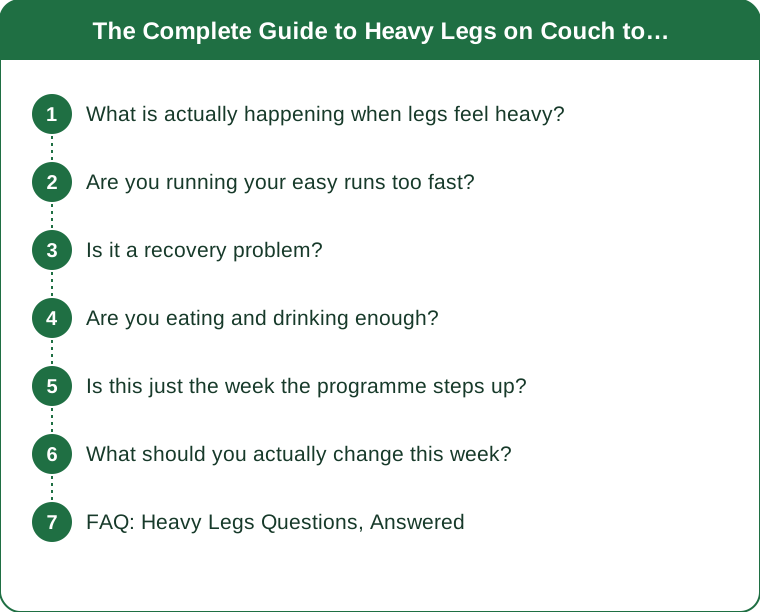
What is actually happening when legs feel heavy?
It is worth separating this from two things it is often confused with.
It is not the same as being out of breath. Breathlessness reflects cardiovascular and respiratory demand, and it improves relatively quickly in new runners — often noticeably within three to four weeks. Heaviness reflects the state of your muscles and your recovery, which operates on a slower timescale.
It is not the same as pain. Heaviness is a diffuse, whole-muscle sensation of effort and reluctance. Pain is localised, sharp, or persistent, and it is a different conversation — see the section on when to stop.
What produces the sensation:
Muscle damage and repair. Running, especially the landing phase, involves eccentric loading — muscles lengthening under tension. This produces microscopic damage that is entirely normal and is part of how adaptation happens. While repair is underway, muscles produce force less efficiently and feel heavier.
Neuromuscular fatigue. Your nervous system’s ability to recruit muscle fibres declines with accumulated fatigue. This is a genuine measurable effect and it feels exactly like heaviness.
Glycogen depletion. Muscles store carbohydrate as glycogen. Depleted stores feel heavy and flat, and this is one of the most common causes in new runners who have not adjusted their eating at all.
Fluid and electrolyte status. Dehydration reduces blood volume and impairs performance noticeably. It is also easy to slip into in autumn, when you do not feel like drinking as much as you did in August but are still losing fluid.
The useful implication of all four: heaviness is a recovery signal, not a fitness signal. People who respond by pushing harder make it worse, and this is by far the most common way C25K goes wrong at this stage.
Are you running your easy runs too fast?
This is the single most likely cause, and almost every new runner does it.
C25K prescribes intervals of running and walking, and it does not prescribe a pace. Left to themselves, new runners run the running portions at a pace that feels like running — which is typically far too fast for the purpose.
The test: you should be able to hold a conversation in full sentences during the running intervals. Not gasped words. Actual sentences. If you cannot, you are running too fast, and this is true for the great majority of people on the programme.
Why it matters so much: running slightly too fast on every session compounds. The programme is designed on the assumption that the running portions are aerobic and recoverable. Run them at a harder intensity and each session generates more fatigue than it was meant to, while the recovery time stays the same. Three sessions a week of slightly-too-hard produces exactly the heavy-legs pattern that shows up around week four or five.
How much slower? Frequently a lot. Many new runners find their genuinely conversational pace is barely faster than a brisk walk, and this feels absurd. It is nonetheless correct, and it is the pace at which the aerobic adaptations actually happen.
Two things that help:
- Run with someone, or talk out loud to yourself. The conversational test only works if you actually test it.
- Ignore the pace number entirely for four weeks. Watching a pace figure is the main thing that keeps people running too fast, because a slow number feels like failure.
A note on hills and wind: both raise effort at the same pace. Slow down on them rather than maintaining pace. The goal is consistent effort, not consistent speed.
Is it a recovery problem?
Very often, and it shows up in three specific places.
Rest days between runs. C25K is designed around a day off between sessions, and this is not a suggestion. New runners’ connective tissue — tendons, ligaments, and bone — adapts considerably more slowly than muscle and cardiovascular fitness do. Running on consecutive days early in the programme is the most common cause of both heavy legs and early injury.
If you are running three days a week with a day between each, you are doing it right. If enthusiasm has crept you up to four or five, that is very likely your answer.
Sleep. This is the biggest single recovery variable and the one people are least willing to hear. Muscle repair, hormonal recovery, and neuromuscular restoration all depend heavily on sleep. A week of six-hour nights produces heavy legs on its own, with no change in training at all.
If your legs got heavy in the same week your schedule changed — a term starting, a new shift pattern, darker mornings — the sleep is more likely the cause than the running.
What you do on rest days. A rest day with an hour of hard gardening or a long day on your feet is not a full recovery day. This does not mean lying down; gentle movement genuinely aids recovery. It means noticing that your legs do not know the difference between a run and eight hours standing.
A practical adjustment: if you have had heavy legs for more than a week, take two consecutive days off, then repeat the last week you completed rather than progressing. Almost everyone who does this reports the following week feeling dramatically easier, and almost nobody wants to do it.

Are you eating and drinking enough?
This is the most fixable cause and the most commonly overlooked.
Carbohydrate. Running uses glycogen, and glycogen comes from carbohydrate. New runners frequently start a running programme at the same time as trying to eat less, which is the specific combination that produces flat, heavy legs.
You do not need a special diet. What you need is enough carbohydrate around your runs:
- Something with carbohydrate 1 to 3 hours before a run. A banana, toast, a bowl of cereal. Running on a completely empty stomach in the evening after a light lunch is a common and avoidable cause of heaviness.
- Something within an hour or two after, including some protein. This supports both glycogen replacement and muscle repair.
- Enough across the day generally. If you are eating in a substantial deficit while starting a running programme, heavy legs are an expected outcome rather than a mystery.
Fluid. Dehydration of even a small percentage of body mass measurably impairs performance. Autumn is a trap here: you sweat less obviously in cool air, you feel less thirsty, and the drinking habit built over summer fades.
Iron. This one is worth flagging specifically. Low iron is relatively common, particularly in women who menstruate, and one of its earliest symptoms is exactly this — legs that feel heavy and effort that feels disproportionate, without breathlessness being the limiting factor. If heaviness is persistent, does not respond to rest, and is accompanied by general fatigue, ask your doctor about a blood test. Do not start iron supplements without being tested — excess iron is harmful. This is general information, not medical advice.
Caffeine and alcohol both affect this: caffeine can help performance modestly, alcohol impairs recovery and sleep quality meaningfully.
Is this just the week the programme steps up?
Often, yes — and knowing where the steps are removes a lot of unnecessary worry.
C25K is not a smooth progression. It contains a few points where the demand increases substantially, and these are where people most commonly feel like they have hit a wall.
The most notorious is week five, where the programme moves from intervals to a single continuous run. That is a genuine change in the nature of the demand, not just more of the same, and feeling significantly heavier and harder that week is the normal experience rather than a sign of failure.
What the step-up weeks require:
- Extra recovery around them. An additional rest day in a step-up week is a good decision, not a concession.
- Slower pace, deliberately. A longer continuous run at the same pace as your intervals is a much harder session. Slow down.
- Permission to repeat. Repeating a week is completely standard and it is built into how experienced runners think about progression. The programme is a template, not a contract.
How to tell a step-up week from a problem:
- Step-up fatigue improves within two or three days and the next session feels better.
- A genuine problem persists across sessions, gets worse rather than better, or is accompanied by other symptoms.
The general principle worth internalising: progress in running is not linear, and the weeks that feel worst are frequently the ones where the most adaptation is happening. Beginners who accept this finish the programme; beginners who read a bad week as evidence of failure are the ones who stop.
What should you actually change this week?
In order, and only one or two at a time so you can tell what worked.
1. Slow down the running intervals. Test conversationally, every run, for two weeks. This fixes more cases than everything else combined, and it costs nothing.
2. Take a genuine rest day between every run. If you have been running consecutive days, stop. If you have been doing something strenuous on rest days, make one of them properly easy.
3. Eat something with carbohydrate 1 to 3 hours before running, and something with carbohydrate and protein within two hours after.
4. Look at your sleep for the last fortnight. If it has dropped, that is likely the cause and no training change will fix it.
5. Drink more, particularly on non-running days. Hydration is a rolling state, not something you fix an hour before.
6. If heaviness persists after two weeks of the above, repeat a week rather than progressing, and take two consecutive rest days first.
7. If it still persists, see a doctor. Persistent, unexplained heaviness and fatigue that does not respond to rest is worth investigating — low iron, thyroid function, and several other things are checkable and treatable. This is general information, not medical advice.
What not to do:
- Do not push through repeatedly. Heaviness is a recovery signal, and overriding it is how new runners end up with shin splints or a stress reaction.
- Do not add extra sessions to catch up. More volume on inadequate recovery makes it worse in a predictable way.
- Do not buy new shoes as a first response. Shoes matter, and they are rarely the cause of diffuse heaviness in both legs. Localised pain is a different matter.
FAQ: Heavy Legs Questions, Answered
How is this different from DOMS?
Delayed onset muscle soreness peaks roughly 24 to 72 hours after an unfamiliar or intense session and is tender to touch. Heaviness is a sensation of effort and reluctance during activity, is not usually tender, and reflects accumulated fatigue rather than a single hard session. They can occur together, particularly early in a programme.
Should I run when my legs feel heavy?
Mild heaviness, yes — an easy run often feels better after the first ten minutes, and gentle movement supports recovery. Significant heaviness that has not improved over several days means take the rest instead. There is no benefit to a session run in a heavily fatigued state, and there is real risk.
Do compression garments help?
Evidence for performance benefit is mixed. Some people report they feel better wearing them for recovery afterwards, and there is little downside. Treat them as a marginal comfort item rather than a solution to a recovery deficit.
Will this go away as I get fitter?
Largely, yes. As connective tissue adapts and your aerobic base develops, the same sessions generate less fatigue and recovery gets faster. Most people find the heaviness that dominates weeks four to six is much less prominent by week eight, provided they slowed down rather than pushed on.
When is heaviness a reason to see a doctor?
If it is persistent for more than two or three weeks despite proper rest, if it comes with general fatigue, breathlessness at rest, dizziness, or unusual paleness, or if it is one-sided with swelling or pain. Any of those warrants a conversation with a doctor rather than a training adjustment. This is general information, not medical advice.
TL;DR:
- Heaviness is a recovery signal, not a fitness signal. Breathlessness improves fast; heaviness improves slowly.
- Most likely cause: you are running the easy intervals too fast. Test conversationally — full sentences, every run.
- Take a genuine rest day between every session. Connective tissue adapts far more slowly than fitness does.
- Eat carbohydrate 1 to 3 hours before and carbohydrate plus protein after. Starting a running programme in a deficit produces exactly this.
- Check your sleep. A fortnight of short nights causes heavy legs with no training change at all.
- Week five is a genuine step up. Repeating a week is standard practice, not failure.
- Persistent heaviness with general fatigue is worth a blood test — ask your doctor, and do not self-supplement iron.
Do not push through it, do not add sessions, do not buy shoes. Slow down and rest. This is general information, not medical advice.
Keep Reading
This article is for general informational purposes only and is not medical advice. Always consult a qualified health professional for guidance specific to you.