The C25K Breathing Technique That Actually Fixes Side Stitches and Early Fatigue
Quick Answer: The most effective breathing technique for Couch to 5K runners is a fixed rhythm pattern - typically inhaling for 3 footstrikes and exhaling for 2 (a 3:2 ratio) - rather than trying to consciously control breath depth or speed directly. This asymmetric rhythm reduces side stitches and helps regulate effort more reliably than “just breathe naturally” advice.
New runners get told to “breathe naturally” as if that solves anything, right before gasping through their first interval anyway. Here’s the actual technique - a specific footstrike-based rhythm - that gives your breathing something concrete to follow.

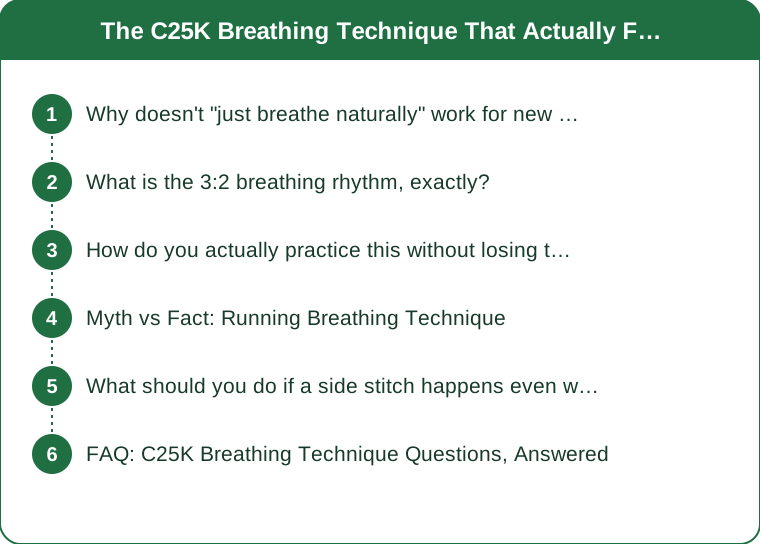
Why doesn’t “just breathe naturally” work for new runners?
The problem with “breathe naturally” is that running isn’t a natural state for most beginners’ cardiovascular systems yet, so “natural” breathing under that stress often defaults to short, shallow chest breathing - exactly the pattern that leads to early fatigue and side stitches. Without a structure to fall back on, breathing tends to speed up and shallow out as effort increases, compounding the problem instead of correcting it.
A rhythm-based technique gives your breathing an external structure to hold onto when your body’s instinct is to panic-breathe, which is precisely the moment a fixed pattern is most useful - not when things feel easy, but when effort starts climbing.
What is the 3:2 breathing rhythm, exactly?
The technique: inhale for 3 footstrikes, exhale for 2 footstrikes, repeating this pattern continuously as you run. So if your right foot strikes first, you’d inhale as right-left-right lands, then exhale as left-right lands, and the cycle repeats - meaning the foot that’s striking as you exhale actually alternates each cycle, which is the specific detail that helps prevent one-sided stitches.
This asymmetric ratio (odd inhale, even exhale count) is intentional - it means your exhale doesn’t always land on the same foot, which distributes the impact-related stress on your diaphragm evenly between both sides of your body over time. A symmetric ratio like 2:2, by contrast, means the same foot always strikes during your exhale, concentrating that stress on one side repeatedly - a commonly cited contributor to side stitches specifically on that side.
For slower jogging paces common in early C25K weeks, a 4:3 ratio (4 footstrikes inhale, 3 exhale) works even better, since it gives you more total breath volume per cycle without needing to breathe faster - useful in week 1-3 when your pace is naturally slower and your lung capacity for running specifically is still building.
How do you actually practice this without losing track mid-run?
Start by practicing off the run entirely - while walking, count your steps and match your breath to the 3:2 pattern until it feels close to automatic, since trying to learn a new counting system while also running for the first time adds unnecessary difficulty.
Once running, count out loud under your breath for the first few minutes of each session until the rhythm locks in - “in-2-3, out-2” - then let it fade into the background once it feels natural. Most runners report the counting becomes unconscious within 2-3 weeks of consistent practice, at which point you stop actively counting and just notice when the rhythm has drifted.
If you lose the rhythm mid-run (which happens to everyone, especially on hills or during the running intervals of C25K when effort spikes), simply reset at your next inhale rather than trying to force the pattern to realign mid-breath - a clean restart works better than a mid-cycle correction.

Myth vs Fact: Running Breathing Technique
Myth: You should always breathe in through your nose and out through your mouth while running. Fact: Most runners, especially at moderate-to-higher effort, breathe through both nose and mouth simultaneously for maximum airflow - restricting yourself to nose-only breathing limits oxygen intake right when you need it most.
Myth: Belly breathing versus chest breathing is the main thing beginners should focus on. Fact: While diaphragmatic (belly) breathing does support better oxygen exchange, rhythm and consistency matter more for new runners specifically - a beginner who breathes rhythmically from the chest will generally outperform one breathing from the belly with no consistent pattern at all.
Myth: Side stitches mean something is wrong with your running form. Fact: Side stitches are extremely common in new runners and are more closely linked to breathing rhythm and pre-run eating timing than to form - fixing the breathing rhythm resolves many stitches without any form changes needed at all.
What should you do if a side stitch happens even with good breathing rhythm?
Exhale forcefully on the foot strike opposite the stitch side - if the stitch is on your right, focus your next several exhales to land specifically on your left foot strikes. This adjustment often eases a stitch within 30-60 seconds without needing to stop running entirely.
If the stitch persists, slow to a walk for 30-60 seconds while taking a few deep, slow belly breaths, then ease back into your running pace and rhythm. This is far more effective than powering through at full pace, which tends to intensify a stitch rather than resolve it.
Prevention matters too: eating a large meal within 60-90 minutes of a run is one of the more common stitch triggers regardless of breathing technique, so timing your last meal earlier can reduce how often stitches happen in the first place.
FAQ: C25K Breathing Technique Questions, Answered
How long does it take to make the 3:2 breathing rhythm feel automatic?
Most new runners report it starting to feel natural within 2-3 weeks of consistent practice, roughly aligning with the middle weeks of a typical C25K program.
Should the breathing ratio change as I get fitter and run faster?
Yes - many runners shift toward a 2:1 ratio (2 footstrikes inhale, 1 exhale) as pace increases and breathing needs to speed up, while keeping the same asymmetric, alternating-foot principle.
Is it bad if I can’t maintain the rhythm during the harder running intervals of C25K?
No, that’s expected - effort spikes during intervals naturally disrupt any breathing pattern, and simply returning to the rhythm during your walk recovery intervals is enough; you don’t need to force it during the hardest moments.
TL;DR:
- “Breathe naturally” doesn’t work well for beginners because natural running breath often defaults to shallow and fast
- A 3:2 (or 4:3 at slower paces) footstrike-based breathing rhythm gives structure and alternates which foot lands on your exhale
- Practice the rhythm while walking first, then counting out loud during early runs
- If a stitch hits, exhale hard on the foot opposite the pain and briefly slow to a walk if needed
Give the rhythm 2-3 weeks of consistent practice before judging whether it’s working - like any new pattern, it needs to become automatic before it stops feeling like extra effort.
Keep Reading
This article is for general informational purposes only and is not medical advice. Always consult a qualified health professional for guidance specific to you.