What Is Actually Happening in Your Body During a Couch to 5K Program, Week by Week
Quick Answer: A Couch to 5K program works by progressively overloading your cardiovascular and muscular systems in a way that triggers specific, well-understood adaptations — increased stroke volume, improved oxygen delivery, and stronger connective tissue — which is why the run-walk structure isn’t arbitrary, it’s built around how quickly your body can actually adapt to new stress.
The run-walk intervals can feel like an arbitrary beginner crutch, something to get past as fast as possible. They’re actually built around real physiological timelines your body needs to adapt safely, and understanding those timelines changes how you approach the program.

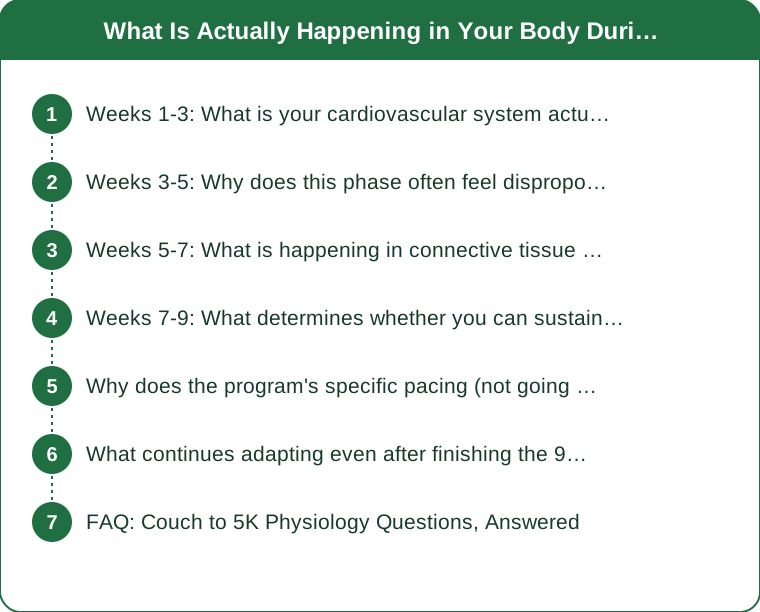
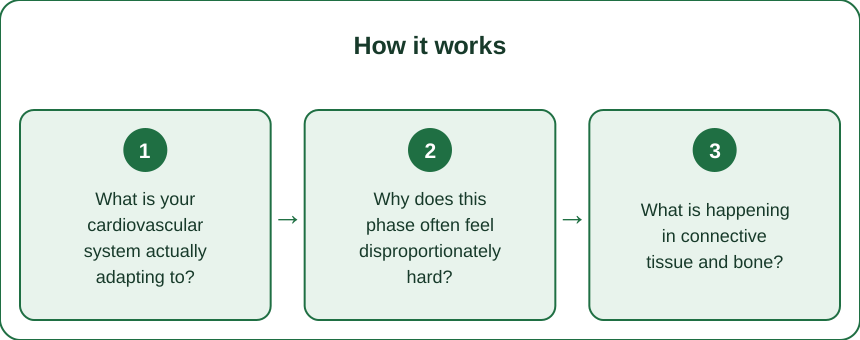
Weeks 1-3: What is your cardiovascular system actually adapting to?
In the earliest weeks, your heart begins increasing stroke volume — the amount of blood pumped per heartbeat — which is one of the fastest-responding cardiovascular adaptations to new aerobic stress. This is part of why resting heart rate often starts dropping noticeably within the first few weeks of consistent training, even before running fitness feels meaningfully different.
The run-walk structure specifically exists because your cardiovascular system adapts faster than your musculoskeletal system does — the walk intervals aren’t primarily about your lungs recovering, they’re pacing the mechanical stress on tendons, ligaments, and bone that adapt on a slower timeline than your heart and lungs.
Weeks 3-5: Why does this phase often feel disproportionately hard?
This is typically where cardiovascular adaptation, which came fast, starts to plateau slightly while musculoskeletal adaptation is still catching up — a mismatch that can make weeks 3-5 feel harder relative to progress than the earlier weeks did, even though real fitness gains are still happening underneath.
Mitochondrial density (which affects how efficiently your muscles use oxygen) is increasing during this window too, but this adaptation has a longer timeline, generally taking 6+ weeks of consistent training to produce a clearly noticeable difference in how running actually feels.
Weeks 5-7: What is happening in connective tissue and bone?
Tendons, ligaments, and bone density adapt to new mechanical loading, but on a meaningfully slower timeline than cardiovascular fitness — often 8-12 weeks or more for measurable structural adaptation, which is a major reason running injuries cluster in this mid-program window when people increase mileage faster than this tissue has adapted.
This is the physiological basis for the well-known ‘don’t increase mileage more than 10% per week’ guidance — it’s pacing progression to roughly match how quickly connective tissue can actually remodel and strengthen, not an arbitrary caution.

Weeks 7-9: What determines whether you can sustain a continuous run?
By this stage, the combination of increased stroke volume, improved mitochondrial density, and partially adapted connective tissue typically converges to make continuous running for 20-30 minutes achievable for most previously sedentary beginners — a genuinely different physiological state than week one, not simply ‘more practice’ at the same underlying fitness.
Running economy — how efficiently your body uses oxygen at a given pace — also improves through this window via better running mechanics developed through repetition, independent of raw cardiovascular fitness.
Why does the program’s specific pacing (not going faster than the plan) matter?
Because the walk intervals and gradual mileage increase are calibrated to the slowest-adapting system in the chain — connective tissue and bone — not the fastest. Skipping ahead in the program outpaces cardiovascular readiness relative to structural readiness, which is exactly the injury risk profile most beginner running injuries fall into.
This is also why people who feel ‘ready to skip ahead’ cardiovascularly by week 3-4 are often not actually structurally ready yet — the two systems are adapting on genuinely different timelines, and the program is built around the slower one.
What continues adapting even after finishing the 9-week program?
Bone density and full connective tissue remodeling in response to running specifically can continue for many months beyond the initial 9-week program, which is part of why injury risk doesn’t disappear the moment you complete Couch to 5K — continuing a gradual mileage progression well past the program’s end still matters.
FAQ: Couch to 5K Physiology Questions, Answered
Why do I feel cardiovascularly ready to run more before my body seems ready?
Cardiovascular adaptation genuinely does happen faster than musculoskeletal adaptation — this mismatch is well documented and is exactly why the program paces mileage increases conservatively.
Does everyone adapt on the same timeline?
No — age, prior activity level, and individual variation all affect adaptation speed, which is why the program allows repeating weeks rather than enforcing a rigid one-size-fits-all schedule.
Is it normal for progress to feel like it stalls around week 4-5?
Yes, this is a commonly reported experience and lines up with the cardiovascular-versus-structural adaptation mismatch described above — it typically resolves as the slower-adapting systems catch up.
TL;DR:
- Cardiovascular adaptation (stroke volume, mitochondrial density) happens faster than musculoskeletal adaptation
- The run-walk structure and gradual mileage increase are paced around the slower-adapting connective tissue and bone
- Weeks 3-5 often feel disproportionately hard due to this adaptation mismatch, not a lack of progress
- Bone and connective tissue remodeling continues well beyond the 9-week program itself
This is general information, not medical advice — individual adaptation timelines vary, so repeat weeks as needed rather than forcing the calendar.
Keep Reading
This article is for general informational purposes only and is not medical advice. Always consult a qualified health professional for guidance specific to you.