Should You Add Strength Training During Couch to 5K? The Complete Guide
Quick Answer: Adding 1-2 short strength sessions per week during Couch to 5K generally supports injury prevention and running performance rather than hindering progress, as long as sessions are scheduled on non-running or easy days and don’t leave legs too fatigued for the next scheduled run.
Most C25K programs are built purely around the running progression itself, which makes sense as the core focus — but it leaves a real question unanswered: does adding strength training help, hurt, or just complicate an already-demanding new habit?

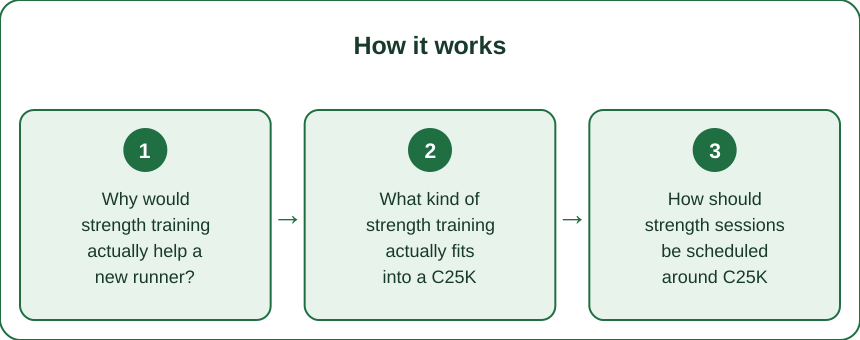
Why would strength training actually help a new runner?
New runners are particularly susceptible to common overuse injuries — shin splints, knee pain, IT band issues — that often stem partly from weak supporting muscles (glutes, hips, core) not yet able to stabilize the repetitive impact of running.
Strength training that targets these specific areas can measurably reduce injury risk during a new running program, which matters enormously for a Couch to 5K context specifically, since an injury early in the program is one of the most common reasons people don’t complete it.
What kind of strength training actually fits into a C25K schedule?
Short, targeted sessions (20-30 minutes) focused on glutes, hips, and core — think squats, glute bridges, planks, and single-leg balance work — provide most of the injury-prevention benefit without the extensive time commitment or fatigue of a full traditional strength program.
This doesn’t need to mean a separate gym membership or heavy lifting; bodyweight or light-resistance versions of these movements, done consistently, cover most of what a new runner’s body specifically needs support for.
How should strength sessions be scheduled around C25K running days?
Most C25K plans run 3 days a week with rest or easy days between — scheduling strength sessions on 1-2 of those non-running days, rather than immediately before a run day, avoids compounding leg fatigue right when you need fresh legs for the next running interval progression.
If a strength session and a run day must fall close together, doing the run first and strength after (rather than the reverse) generally works better, since fatigued legs going into a run increase both injury risk and the odds of a discouraging, harder-than-expected run session.

The Physiological Adaptation Science Behind Combining Both
Running and strength training create somewhat different physiological adaptations — running primarily builds cardiovascular capacity and running-specific muscular endurance, while strength training builds broader muscular strength and connective tissue resilience, including in areas running alone doesn’t load heavily (like lateral hip stabilizers).
Combining both, when properly balanced, has research support for producing better overall injury resilience than running-only training for new runners specifically — the tissues supporting the ankle, knee, and hip joints benefit from strength stimulus that pure running volume doesn’t fully provide on its own, especially for a body not yet adapted to repetitive impact.
What are the signs you’re doing too much between running and strength?
Persistent, non-improving soreness that affects running form, a noticeable decline in run performance week over week rather than the expected gradual improvement, or new joint pain (as opposed to normal new-runner muscle fatigue) are all signals the combined volume needs scaling back, not pushed through.
For most new runners in a C25K program, 1-2 short strength sessions weekly is a reasonable, sustainable addition; adding more than that alongside a new running habit increases the risk of overreaching before either habit is well established.
What About Nutrition While Combining Both?
Combining running and strength training increases overall recovery demand, which means adequate protein intake (to support muscle repair from both activities) and sufficient overall calories matter more than they would for running alone — under-fueling while adding strength volume is a common way new exercisers stall progress in both areas simultaneously.
FAQ: C25K and Strength Training Questions, Answered
Will strength training make me too sore to run on schedule?
If sessions are appropriately light and scheduled with adequate spacing from run days, soreness should be manageable — starting with lighter volume than you think you need and progressing gradually avoids this problem.
Can I do strength training on the same day as a run?
Yes, generally better after the run than before, so leg fatigue from strength work doesn’t compromise the running session’s quality and increase injury risk.
Do I need gym equipment for effective strength training during C25K?
No — bodyweight exercises targeting glutes, hips, and core cover most of what’s specifically useful for new-runner injury prevention, no equipment required.
TL;DR:
- 1-2 short strength sessions weekly generally reduce injury risk during Couch to 5K, not hinder progress
- Focus on glutes, hips, and core — the areas running alone doesn’t fully stabilize
- Schedule strength on non-running days, or after a run rather than before
- Watch for non-improving soreness or declining run performance as signs to scale back
Strength training isn’t a distraction from the running progression — for most new runners, it’s part of what makes the running progression actually stick.
Keep Reading
This article is for general informational purposes only and is not medical advice. Always consult a qualified health professional for guidance specific to you.