The Complete Guide to Starting Couch to 5K in Autumn
Quick Answer: Autumn is physiologically the best season to start running - cool temperatures make running feel substantially easier than in summer heat - and behaviourally the hardest to sustain, because darkness and weather erode consistency. The plan that works front-loads habit formation in September while conditions are good, and has darkness and rain contingencies decided in advance rather than improvised in November.
More people start Couch to 5K in September than any month except January, and a large proportion stop by November. The physiology is on your side and the environment is not, and knowing which problem you are solving at any point makes the difference.

Why autumn is genuinely the best time to start running
The physiological case is strong and it is worth understanding, because it explains why the first few weeks feel easier than expected.
Heat is a major limiter on running performance, and it is gone. In warm conditions, a substantial proportion of cardiac output is diverted to the skin for cooling rather than to working muscles. This means heart rate is higher at any given pace, perceived effort is greater, and everything feels harder.
Cool conditions remove that constraint. Most people find running significantly easier in the range of roughly 5-15C than at 25C+. For a complete beginner, that difference can be the gap between a run feeling achievable and feeling impossible.
This matters most for beginners specifically. An experienced runner adjusts pace for heat. A beginner following a fixed programme runs the same intervals regardless of conditions, so summer heat makes an already-hard programme considerably harder.
Air quality is often better in autumn than in high summer in many areas, and pollen levels drop, which matters for anyone whose breathing is affected by it.
The surfaces are good. Early autumn ground is neither baked hard nor waterlogged, and trails and parks are at their most pleasant.
The scenery is at its best, which sounds trivial and is not. Enjoyment predicts adherence more reliably than motivation does, and running through a park in October is genuinely pleasant in a way that running in August heat is not.
The practical implication: the first three or four weeks of an autumn C25K are the easiest they will ever be. Use that window to build the habit rather than to push the pace - the habit is what has to survive November.
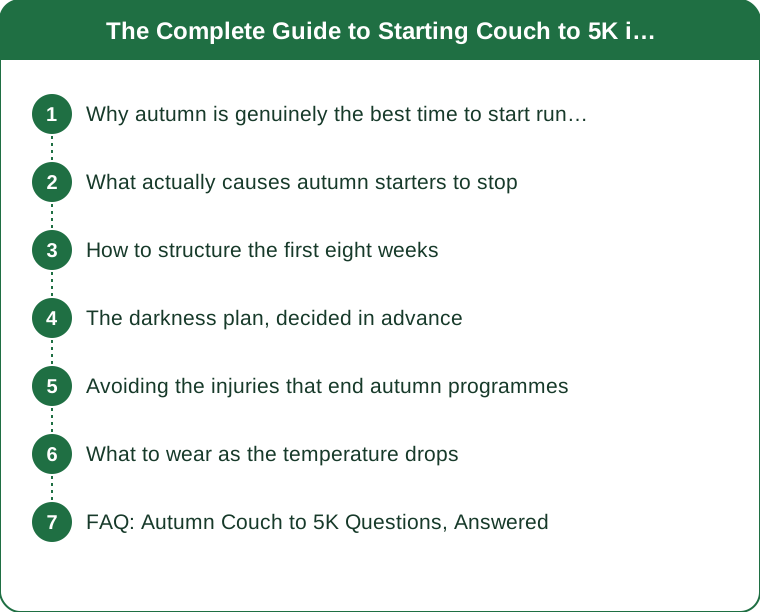
What actually causes autumn starters to stop
Almost never fitness. The failure points are environmental and behavioural, and they are predictable enough to plan for.
Darkness is the biggest one. Sunrise gets later and sunset earlier at the fastest rate of the year through September and October. A routine built around running in daylight after work stops being possible, often within a few weeks, and the schedule does not survive.
This is the single most common reason autumn programmes end, and it is entirely foreseeable in September.
Rain and wind. Not because running in rain is bad - it is generally fine and often pleasant - but because the decision point in the doorway is where habits fail. Without a pre-made decision, rain wins.
Motivation from novelty runs out around week four. The initial enthusiasm carries the first three weeks. Weeks four to six are where the programme becomes a habit or does not, and they coincide with the sharpest reduction in daylight.
Doing too much too soon. The most common physical cause. Because autumn running feels easier, beginners frequently run faster than the programme intends, which produces shin, knee, or Achilles complaints in weeks three to five.
Illness. Cold season starts, a week is missed, and the return never happens. Not because fitness is lost - it barely is - but because the routine broke.
What all of these have in common: they are logistical rather than physical. The programme’s design is not the problem, and neither is your capacity.
How to structure the first eight weeks
Weeks 1-3: Build the habit while conditions are easy.
Three runs weekly, non-consecutive days. Follow the intervals as written and run the running portions slower than feels natural - this is the single most important instruction in the entire programme.
The pace rule: you should be able to speak in full sentences while running. If you cannot, you are running too fast. Most beginners run their intervals far too quickly, which is what produces both the exhaustion and the injuries.
Weeks 4-6: The critical window.
This is where most people stop, and where daylight is disappearing fastest. Decide your dark-weather plan before you need it, in week three, while it is still light.
Expect at least one bad run in this period. A run that feels dramatically harder than the previous one is normal, and it usually reflects sleep, food, or stress rather than a loss of fitness. Repeat the week rather than pushing on.
Weeks 7-9: Consolidation.
The intervals get long enough that it starts to feel like running rather than intervals. This is also where the psychological shift happens for most people.
Repeating weeks is normal and correct. The programme is a guideline, not a schedule. Anyone who repeats three weeks and finishes has done considerably better than anyone who follows it exactly and stops in October.
What to do about missed runs: miss one, continue. Miss a week, repeat the last week. Miss two weeks or more, go back two weeks. Fitness is retained better than most people assume.

The darkness plan, decided in advance
This is the section that determines whether the programme survives, and it needs deciding in September.
Option 1: Move to lunchtime. The most reliable autumn solution if your schedule allows it. Daylight is guaranteed, it is naturally protected, and it removes the after-work decision entirely.
Option 2: Run in the dark, properly equipped. Entirely viable with:
- A head torch for unlit routes. Not optional - it is both for seeing and being seen
- Reflective or high-visibility clothing. Most running kit has some; check that yours does
- A well-lit, familiar route, chosen in daylight first
- Someone knowing your route and expected return time
Option 3: Weekend daylight plus one weekday. Two runs at the weekend in daylight and one during the week accepts a less ideal distribution in exchange for actually happening.
Option 4: Treadmill for the darkest weeks. Less enjoyable for most people and dramatically better than stopping. The C25K intervals translate directly.
What to decide now, in writing:
- Which option is your default from mid-October
- Which specific route you will use in the dark
- What weather stops you - and make the threshold genuinely extreme, like ice or high winds, rather than rain
On running in rain: it is fine, and frequently more pleasant than expected. The problem is never the rain; it is the decision in the doorway. Deciding in advance that rain does not count as a reason removes the decision entirely.
Kit that makes rain manageable: a peaked cap keeps rain off your face, which is most of the discomfort. That is genuinely the main thing.
Avoiding the injuries that end autumn programmes
Beginner running injuries cluster in weeks three to six and are largely preventable.
Shin pain is the most common beginner complaint and usually reflects doing too much too soon or running too fast. Reducing pace and repeating a week resolves most cases.
Knee pain is frequently associated with weak hips and glutes, which is common in people who have not been training. This is the strongest argument for adding strength work.
Achilles and calf issues often relate to a sudden increase in load, or to a change in footwear. Both are more likely if you have been in flat or minimal shoes and suddenly increase volume.
The three things that prevent most of it:
1. Run slower. Repeated because it is the most important. Conversational pace. Most beginner injuries trace back to running the intervals too fast.
2. Add two strength sessions weekly. Squats, lunges, glute bridges, calf raises, and single-leg work. Twenty minutes twice a week substantially supports the tissue capacity that running demands. This is the most under-done thing in every beginner programme.
3. Get shoes that suit you. Not necessarily expensive - suitable. A running shop that watches you run and lets you try several pairs is worth visiting. Running in old trainers with compressed cushioning is a common contributor.
Autumn-specific: wet leaves are genuinely slippery, particularly on painted lines, drain covers, and wooden surfaces. Most autumn falls happen on leaf-covered pavements rather than on trails.
When to stop and get it assessed: pain that changes your running form, pain that persists after a run rather than easing, pain that worsens through a run, or any sharp pain. Ordinary muscle soreness eases as you warm up; something else does not. This is general information, not medical advice - persistent pain warrants a professional opinion rather than pushing through.
What to wear as the temperature drops
Getting this wrong is a common reason people find autumn running unpleasant when it should be the best running of the year.
The core principle: dress for about 10C warmer than the actual temperature. You will be cold for the first five minutes and comfortable thereafter. Almost everyone overdresses, gets too warm by minute ten, and concludes that running in autumn is uncomfortable.
Rough guide by temperature:
- 15C+: shorts and a t-shirt
- 10-15C: shorts or leggings, long-sleeve top
- 5-10C: leggings, long-sleeve, light gloves
- 0-5C: leggings, long-sleeve plus a light layer, gloves, headband or hat
- Below 0C: as above plus a windproof layer, and take extra care on ice
What matters most as it gets colder: hands and ears. Both feel cold disproportionately and both are cheap to cover. A pair of thin gloves and a headband transform cold-weather running for very little money.
Avoid cotton. It holds moisture, stays wet, and becomes cold. Any technical fabric, or wool, performs dramatically better once temperatures drop.
For rain: a peaked cap does more than a jacket for most autumn rain. Fully waterproof jackets tend to trap sweat, which leaves you wet from the inside. A light water-resistant layer plus a cap is usually more comfortable.
Visibility as evenings darken: something reflective on your moving parts - ankles and wrists - is more visible to drivers than a reflective torso, because movement attracts attention.
The warm-down consideration: you cool very quickly after stopping in autumn. Have a dry layer at home ready and change promptly, particularly if you have a walk home.
FAQ: Autumn Couch to 5K Questions, Answered
Is it too late in the year to start?
No. Autumn conditions are physiologically the best of the year for running. The challenge is behavioural, and it is solvable with a plan for darkness and weather.
How slowly should I actually be running?
Slow enough to hold a conversation in full sentences. If you cannot, slow down. This is the most common beginner error and the source of most beginner injuries.
Is it bad to run in the rain or cold?
Generally no, with appropriate clothing. Ice is the genuine exception - it is worth switching to a treadmill or postponing rather than risking a fall.
What if I miss a week because I’m ill?
With a mild cold and symptoms above the neck, easy running is usually fine. With fever, chest symptoms, or feeling genuinely unwell, rest. When you return, repeat the previous week. This is general information, not medical advice.
Do I need to do the programme exactly as written?
No. Repeating weeks is normal and often better. The programme is a guideline, and finishing slowly beats stopping on schedule.
How long until running feels easier?
Most people report a noticeable shift somewhere around weeks five to seven, when the intervals lengthen enough to settle into a rhythm. Before that it is genuinely hard, and that is normal rather than a sign it is not working.
TL;DR:
- Autumn is the easiest season to run in - cool conditions remove the heat constraint that makes summer running so much harder
- Autumn is also the hardest to sustain, and the failure points are darkness, rain, and week four, not fitness
- Use the good September weeks to build the habit, not to push the pace
- Decide your darkness plan in writing in week three, before you need it
- Run at conversational pace and add two short strength sessions weekly - together these prevent most beginner injuries
- Dress for 10C warmer than it is; almost everyone overdresses and concludes autumn running is unpleasant
Repeating weeks is normal. Finishing in December beats following the schedule exactly and stopping in October. This is general information, not medical advice.
See It in Motion
Seen here: Super High Waist Embossed Yoga Leggings with Inner Pocket — shop it on bubblelime.com
Keep Reading
This article is for general informational purposes only and is not medical advice. Always consult a qualified health professional for guidance specific to you.