The Complete Couch to 5K Guide Nobody Gives New Runners: Injury Prevention, Real Progression, and What to Do When It Gets Hard
Quick Answer: Couch to 5K programs work because they follow a run-walk interval structure that lets cardiovascular fitness improve faster than joint and tendon adaptation — meaning the biggest injury risk isn’t running too fast, it’s progressing the schedule faster than your connective tissue can adapt, especially around week 5 when continuous running blocks first appear.
Most Couch to 5K content is just the schedule itself — run 60 seconds, walk 90 seconds, repeat — with little explanation of why certain weeks feel disproportionately hard, why injuries cluster around specific points in the program, or what to actually do when motivation and progress stop lining up. This is the version that covers what those guides skip.

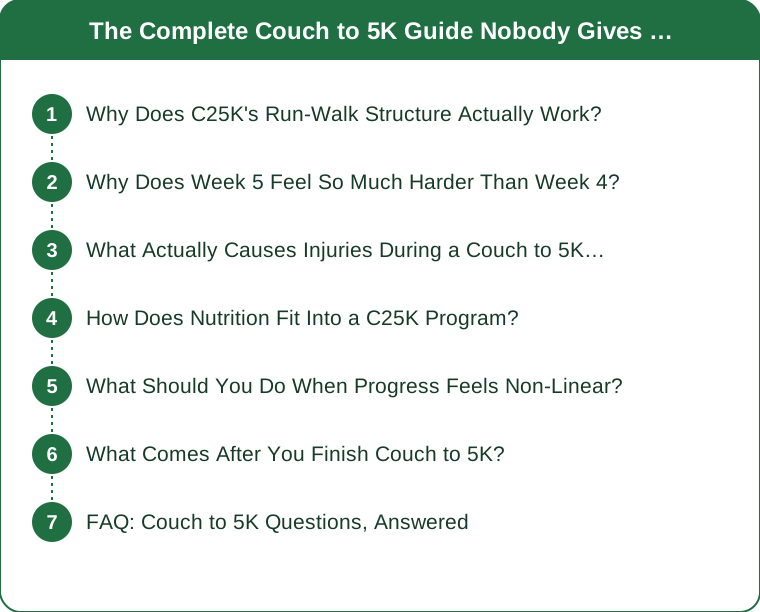
Why Does C25K’s Run-Walk Structure Actually Work?
The interval structure of run-walk-run isn’t just a beginner-friendly gimmick — it reflects a real physiological mismatch between how fast cardiovascular fitness improves versus how slowly tendons, ligaments, and bone density adapt to new loading stress. Your heart and lungs can handle more running volume within just a few weeks, but the connective tissue supporting your joints takes considerably longer, often months, to strengthen in response to new impact loading.
The walk intervals aren’t filler time — they’re recovery windows built directly into the workout, giving joints and tendons brief recovery within the same session rather than only between sessions. This is precisely why skipping ahead in the program, even when you feel cardiovascularly capable of more continuous running, raises injury risk disproportionately: your lungs might be ready, but your shins, knees, and Achilles tendons are on a slower adaptation timeline that doesn’t accelerate just because you feel fine breathing-wise.
Understanding this distinction reframes the entire program: the schedule isn’t paced to your fitness level, it’s paced to your slowest-adapting tissue, which is precisely why it works even for people who could technically run further on cardiovascular capacity alone in the first couple of weeks.
Why Does Week 5 Feel So Much Harder Than Week 4?
Week 5 is where most C25K programs introduce the first continuous running block without a walk interval breaking it up, which represents a meaningfully different demand than anything in the preceding weeks — this is not a failure of your progress if it feels significantly harder, it’s a genuinely bigger jump built into the program’s structure.
The mental component matters as much as the physical one here: previous weeks had a built-in mental finish line every 60-90 seconds via the walk interval, while a continuous run block removes that frequent reset point, which many new runners find surprisingly more taxing psychologically than physically.
If week 5 genuinely isn’t working, repeating it for an additional week rather than pushing forward on schedule is a legitimate, common adjustment — the program’s timeline is a guideline, not a strict requirement, and repeating a tough week has a strong track record of getting people through it on the second attempt.
What Actually Causes Injuries During a Couch to 5K Program?
Shin splints are the most common C25K injury, typically arising from a combination of progressing too quickly, worn-out or inappropriate footwear, and running on hard surfaces exclusively without any variation. They tend to show up as a dull ache along the shin during or after running, distinct from the sharper, more localized pain of a stress fracture.
Running shoes matter more for new runners than experienced ones, somewhat counterintuitively, because a new runner’s body hasn’t yet developed the biomechanical efficiency that lets experienced runners tolerate less-than-ideal footwear. A proper fitting at a specialty running store, rather than guessing at size and cushioning level, meaningfully reduces this risk.
The general rule for distinguishing normal new-runner discomfort from an actual injury: soreness that improves within the first 10 minutes of a subsequent run and doesn’t worsen during activity is typically normal adaptation; pain that gets progressively worse during a run, or that persists and worsens between running sessions rather than easing, warrants rest and possibly a medical evaluation.

How Does Nutrition Fit Into a C25K Program?
New runners often underestimate the nutritional shift required to support new training stress on top of existing daily activity — Couch to 5K represents a real increase in caloric and hydration demand, particularly as weekly running volume builds past the halfway point of the program.
Carbohydrate intake in the hours before a run matters more for new runners than experienced ones, since an untrained body hasn’t yet developed the same efficiency at using stored fat for lower-intensity exercise fuel — a small carbohydrate-containing snack 60-90 minutes before running can meaningfully improve how a session feels, especially in the later weeks with longer continuous blocks.
Hydration needs also increase, though this doesn’t require anything elaborate — water is sufficient for the exercise durations involved in most of the C25K program, with electrolyte considerations becoming more relevant mainly in hot weather or for sessions extending past 60 minutes.
What Should You Do When Progress Feels Non-Linear?
It’s extremely common, not a sign of failure, for progress through a Couch to 5K program to feel non-linear — a great run one week followed by a surprisingly difficult repeat of the same workout the following week. Sleep quality, stress levels, hydration, and even monthly hormonal cycles all affect a given session’s difficulty independent of actual fitness progress.
Tracking overall trend across several weeks, rather than judging fitness by any single session, gives a much more accurate picture of actual progress than a day-to-day comparison, which is noisy enough to be genuinely misleading if taken too literally.
When a specific week consistently feels harder than expected despite repeated attempts, treadmill pace mismatches with outdoor perceived effort (a well-documented phenomenon due to the belt assisting leg turnover) are worth ruling out as an explanation before assuming a fitness plateau.
What Comes After You Finish Couch to 5K?
Finishing the program doesn’t mean training should stop evolving — many new runners plateau specifically because they keep repeating the final week’s structure indefinitely rather than progressing to a genuine 5K-focused training plan or exploring a 10K progression once 5K distance feels comfortable.
First 5K race day planning deserves its own preparation beyond just training volume: arriving with a familiar pre-run routine, realistic pacing goals (many new racers go out too fast on race day adrenaline), and appropriate rest in the final 2-3 days before the race all matter as much as the training itself.
Rest day activities during ongoing training — light walking, gentle stretching, or a completely different low-impact activity — support recovery better than complete inactivity, without adding meaningful additional impact stress on the same tissues that need recovery time.
FAQ: Couch to 5K Questions, Answered
Is it normal for week 5 to feel much harder than earlier weeks?
Yes — week 5 typically introduces the first continuous running block without walk breaks, which is a genuinely bigger structural jump than anything in the preceding weeks, not a sign of insufficient progress.
What’s the difference between normal new-runner soreness and an actual injury?
Soreness that improves within the first several minutes of a run and doesn’t worsen during the session is typically normal; pain that worsens during running or between sessions warrants rest and possibly medical evaluation.
Should I repeat a week if it feels too hard to progress from?
Yes, this is a legitimate and common adjustment — the program’s timeline is a guideline, and repeating a difficult week has a strong track record of success on a second attempt.
Why does my treadmill pace feel so much easier than the same pace outdoors?
Treadmill belts assist leg turnover slightly, and the lack of wind resistance and environmental variables make an identical displayed pace feel meaningfully easier than the same pace run outdoors.
TL;DR:
- The run-walk structure exists because tendons and joints adapt slower than cardiovascular fitness — respecting the schedule matters more than feeling capable of more
- Week 5’s difficulty jump is structural (first continuous run block), not a sign you’re behind
- Shin splints are the most common C25K injury, usually from progressing too fast or worn-out shoes
- Nutrition and hydration needs increase meaningfully as weekly volume builds — a small pre-run carb snack helps
- Progress is normally non-linear; judge trend over weeks, not any single session
- Repeating a hard week is a legitimate, common adjustment, not a failure
This is general information, not medical advice — persistent or worsening pain deserves a professional evaluation rather than pushing through the schedule. The program works because it respects your body’s real adaptation timeline; the biggest mistake most new runners make is trying to outrun that timeline instead of trusting it.
Keep Reading
This article is for general informational purposes only and is not medical advice. Always consult a qualified health professional for guidance specific to you.