Couch to 5K as the Weather Cools: The Complete Adjustment Guide
Quick Answer: Cooler weather makes running easier - most beginners run 15-30 seconds per mile faster at 50-60F than at 80F, at the same effort. But the transition brings four specific risks: warming up too little, going out too fast because it feels easy, underdressing or overdressing, and losing sessions to shorter daylight. Extend the warm-up to 10 minutes, run by effort rather than pace, dress for 15-20F warmer than the thermometer, and move your run before you lose the light rather than after.
If you started Couch to 5K in June and it’s felt like a fight every session, here’s some good news: the next few weeks are when it starts feeling possible. Cooler air is genuinely easier to run in, and the improvement isn’t in your head.
But the transition has its own failure modes, and they take out a predictable share of beginners every autumn. This is the full picture - physiology, pacing, kit, and the specific week-by-week adjustments that keep the plan on track.
This is general information, not medical advice. New or worsening pain, chest symptoms, or dizziness while running warrants seeing a doctor rather than adjusting a plan.
Why does running actually get easier when it cools down?
The mechanism is thermoregulation, and the size of the effect surprises people.
Running generates a large amount of heat. Only about 20-25% of the energy your muscles produce becomes forward motion; the rest becomes heat. In hot conditions your body has to divert a meaningful share of blood flow to the skin to shed that heat, and blood at the skin isn’t delivering oxygen to working muscles.
This is why heart rate climbs in the heat at the same pace. The phenomenon has a name - cardiac drift - and it’s why a run that felt controlled in the first mile becomes a struggle by the third on a hot day. Heart rate can run 10-20 beats per minute higher at identical pace in hot conditions, purely from the cooling demand.
The cool-weather payoff: at around 50-60F, the cooling demand drops sharply and that blood flow goes back to the muscles. Research on marathon performance consistently identifies a temperature band in the 40s-50s F as optimal, with performance declining steadily above it. For a beginner, the practical translation is 15-30 seconds per mile faster at the same perceived effort, and often more if you started in real heat.
Humidity matters as much as temperature. Sweat cools you only when it evaporates. In high humidity it drips instead, so you lose fluid without getting the cooling benefit - which is why an 80F humid morning feels far worse than an 85F dry one. Autumn typically brings both temperature and humidity down together, and the combined effect is larger than either alone.
What this means for your plan: the week you notice running got easier is not the week you got fitter overnight. It’s mostly the weather - and understanding that keeps you from concluding you’ve plateaued when it warms up again for a few days.
The trap embedded in this: because it feels easier, beginners speed up. Speeding up is exactly what the next section is about, because it’s the single most common way this transition goes wrong.
How should you adjust pace when everything suddenly feels easier?
You shouldn’t - at least not deliberately. Here’s why, and what to do instead.
The core principle of Couch to 5K is time on feet, not speed. The plan works by progressively increasing the duration of running intervals while your tendons, ligaments, and bones adapt. Those tissues adapt far more slowly than your cardiovascular system does - typically weeks to months rather than days.
The autumn trap: cardiovascular fitness improves quickly and the cooler weather adds another jump. So your lungs and heart feel ready for more before your connective tissue is. This mismatch is the mechanism behind most beginner running injuries, and the cool-weather transition widens it.
Run by effort, not by pace. The talk test is the most reliable tool a beginner has: you should be able to speak a full sentence while running, with a little effort. If you can only manage three words, you’re running your easy intervals too hard - regardless of what the watch says.
Let the improvement show up as easier, not faster. The correct response to a run feeling easier is finishing it feeling good and being ready for the next one. The incorrect response is turning the same session into a hard one.
If you genuinely want to use the fitness, here are the safe outlets:
- Finish the run feeling like you could do one more interval. That’s the target every session.
- Add a walk before and after rather than running faster. More total time on feet, no additional impact intensity.
- Hold to the plan’s progression and let the last week of the programme be the one where you find out how much faster you got.
The 10% guideline still applies. Increasing weekly running volume by more than about 10% raises injury risk, and the guideline doesn’t get suspended because the weather improved. If you were running 60 minutes total last week, 66 is the ceiling this week - not 90 because it felt good.
One legitimate adjustment: if you were forced to cut intervals short in summer heat and repeated weeks, you may now complete the week you were stuck on. Completing the plan as written is not the same as accelerating it, and that’s the distinction to hold onto.
How much longer should your warm-up be in cool weather?
Roughly double, and this is the most under-appreciated change of the whole transition.
Why cold changes warm-up requirements. Muscle and tendon are viscoelastic - their mechanical properties depend on temperature. Cold tissue is stiffer, less compliant, and absorbs less energy before failing. In warm weather you arrive at the start of a run already partly warm; in cool weather you don’t.
The summer habit that becomes an autumn problem: in July, a three-minute walk was plenty because you were already warm from standing outside. In October the same three minutes leaves you starting your first run interval on cold tissue - and the first interval is when calf strains and Achilles complaints happen.
The autumn warm-up, about 10 minutes:
- 5 minutes brisk walking, gradually increasing pace
- Leg swings, 10 each leg forward-back and side-to-side
- 10 walking lunges
- 20 ankle circles each direction, which matters more than people expect for calf and Achilles
- 30-60 seconds of very easy jogging before the first proper interval
Dynamic, not static. Hold-and-stretch before running has not been shown to reduce injury risk and may briefly reduce power output. Movement that takes joints through range under control is what you want - the stretching, if you do it, belongs after.
The calf and Achilles get special attention because they’re the tissues most affected by cold and the most common site of beginner running injury in autumn. Add 10-15 slow calf raises to the warm-up from September onwards; it takes 40 seconds and addresses the highest-probability problem.
Cool-down changes too. In summer you cooled down naturally; in autumn you get cold fast once you stop. Walk 5 minutes, then get inside and change out of damp kit promptly. Standing around in sweat-soaked clothing in a breeze is how a good session turns into a miserable evening.
A note on stiffness the day after: slightly more next-day stiffness in cool weather is normal and not a sign of injury. Pain that’s sharp, localised, or present at the start of a run rather than fading is different - that’s the signal to stop and get it looked at.

What should you actually wear as the temperature drops?
One rule covers most of it, and then a few specifics.
Dress for 15-20F warmer than the thermometer reads. You generate a great deal of heat once running, and the temperature you feel at minute 15 is very different from the one at minute zero. If you feel comfortable standing outside before you start, you’re overdressed. Feeling slightly cold at the door is correct.
The layer guide by temperature:
- 60F+ - shorts or capris, short-sleeve top. No change from summer.
- 50-60F - full-length leggings or shorts by preference, long-sleeve top. Most people overdress in this band.
- 40-50F - leggings, long-sleeve top, light gloves. Hands and ears get cold before your torso does, and cheap gloves solve more comfort complaints than an extra top layer.
- 30-40F - leggings, base layer plus light jacket, gloves, headband or hat.
- Windy anything - add a wind-resistant shell. Wind is worth roughly 10-15F of perceived cold and cuts straight through knits.
Fabric matters more as it cools. Cotton holds moisture, stops insulating when wet, and stays wet. In summer a damp cotton shirt is just uncomfortable; in autumn it makes you genuinely cold for the entire second half of a run. Technical synthetics or merino wick and keep insulating when damp.
Visibility becomes a real safety issue. Daylight shortens quickly through September and October. Reflective elements on the moving parts - ankles and wrists - are far more visible to drivers than a reflective strip on your back, because motion is what catches the eye. A clip-on light is inexpensive and worth it.
Extremities first, torso second. The instinct is to add a jacket; the better move is usually gloves and something over the ears. Blood flow prioritises the core, so hands and ears cool first - warming them makes the whole run feel warmer without overheating your torso.
One overlooked item: a dry top to change into immediately after. The post-run chill is worse than anything during the run, and it’s the reason a lot of people quietly stop doing outdoor sessions in October.
What about losing the daylight?
This ends more Couch to 5K attempts than injury does, and it’s entirely solvable with planning.
The problem is structural, not motivational. If your run happened at 6:30pm all summer, at some point in September that slot goes dark. Most people don’t decide to stop - they miss one session because of the light, then another, and the habit dissolves. Recognising it as a scheduling problem rather than a willpower one is most of the fix.
Decide before it happens, not after. Look at sunset times for the next six weeks now and identify the date your current slot stops working. Move the run before that date, while the habit is still intact - moving a habit that’s already broken is much harder than shifting one that’s running.
The options, in rough order of reliability:
Morning. The most robust choice because daylight is gaining at the start of the day for part of the autumn and morning slots are less prone to being eaten by work. The cost is a genuinely hard adjustment period of about two weeks, and going to bed earlier is the part that actually makes it work.
Lunchtime. Underrated. The middle of the day is the warmest and brightest window, and a 30-minute session fits most lunch breaks with a quick change.
Lit routes after dark. Entirely viable with the right precautions: well-lit paths, a headlamp or clip light, reflective kit, no headphones in both ears, and telling someone your route. Loops near home beat point-to-point routes in the dark.
Treadmill for the darkest weeks. Not a defeat. Set the incline to 1% to approximate outdoor effort, and understand that treadmill pace and outdoor pace won’t match - go by effort and interval time, which is what the plan actually asks for.
The seasonal-mood factor is real too. Reduced light affects energy and motivation for many people, and morning outdoor exercise is one of the better countermeasures because it delivers bright light early. If the low-energy stretch hits hard enough to affect daily functioning, that’s worth raising with a doctor rather than treating as a training problem.
What Nobody Tells You About the Summer-to-Autumn Running Transition
Six things that only show up once you’ve been through it.
Your pace from July was artificially slow, so your autumn pace isn’t real progress either. Both numbers are weather-influenced. The only honest comparison is same-season to same-season, which means your true baseline is next spring. Judging progress week to week across a changing season produces false confidence and false despair in equal measure.
Breathing feels different in cool air and it’s not a problem. Cold, dry air can make the throat and chest feel tight or produce a slight cough after hard efforts. Breathing through the nose in the first few minutes and using a light neck gaiter over the mouth in genuinely cold weather both help by warming and humidifying the air. Persistent wheeze or breathlessness disproportionate to effort is a different matter and worth medical review.
You’ll need to drink even though you don’t feel thirsty. Thirst signalling is blunted in cool weather and you still lose meaningful fluid through sweat and respiration. Dehydration in autumn is common precisely because it doesn’t announce itself.
The first cold session is disproportionately unpleasant and then it isn’t. There’s a genuine acclimatisation period of roughly two weeks. A lot of people quit on the evidence of one bad cold run, which is the least representative data point available.
Shoes lose grip on wet leaves, and wet leaves are slipperier than rain. A layer of wet leaves on pavement is genuinely hazardous. Shorten your stride and avoid the leaf line at the edge of the path, particularly on corners and downhills.
Consistency in autumn is worth more than performance in summer. The people who finish Couch to 5K are the ones who solved the daylight problem in week two of September rather than the ones who ran fastest in August. The whole thing is a scheduling exercise wearing a fitness costume.
FAQ: Autumn Couch to 5K Questions, Answered
Should I repeat a week if I struggled through summer?
Repeat any week you couldn’t complete as written, and there’s no penalty for it. Many people repeat weeks 5 and 6 regardless of season - those are where interval length jumps most. The plan is a template, not a contract.
Is it safe to run in the rain?
Yes, with attention to two things: footing, and getting warm and dry quickly afterwards. The health risk isn’t the rain itself, it’s standing around cold and wet after. Choose routes without slick surfaces and put dry clothes on immediately.
Why does my chest hurt slightly in cold air?
Cold dry air can irritate the airways and produce a tight or burning sensation, especially at higher efforts. Warming the air through a gaiter or nose breathing usually resolves it. Chest pain that’s pressure-like, radiates, or comes with breathlessness or nausea is not this and needs urgent medical attention.
Do I need different shoes for autumn?
Not usually. A road shoe handles wet pavement fine. If your route turns to mud or trail, a trail shoe with deeper lugs is worth it - but for most people the answer is the same shoes plus more care on wet leaves.
How do I stay motivated when it’s dark and cold?
Remove decisions rather than summoning willpower: kit laid out the night before, a fixed slot in the calendar, and a defined route. Also, running with someone or committing to a specific 5K event in the spring gives the autumn sessions a reason to exist beyond the weather.
Will I lose fitness if I take two weeks off?
Barely. Cardiovascular fitness declines slowly at first - a fortnight off costs very little and is far cheaper than training through an injury for a month. Restart one week back in the plan and you’ll catch up quickly.
TL;DR:
- Cooler air genuinely makes running easier - 15-30 seconds per mile at the same effort is typical, and it’s the weather, not a sudden fitness jump
- Don’t spend the improvement on speed; connective tissue adapts far slower than your heart and lungs
- Double the warm-up to about 10 minutes, and add calf raises - cold tissue is stiffer and the calf and Achilles pay for it
- Dress for 15-20F warmer than it is; if you’re comfortable standing outside, you’re overdressed
- Solve the daylight problem before it breaks the habit, not after - that’s what ends most autumn attempts
- Extremities cool first: gloves and an ear covering beat an extra torso layer
- Judge progress season to season, not week to week
The next eight weeks are the best running weather of the year. The plan that survives them is the one where you decided in advance what to do about the dark.
See It in Motion
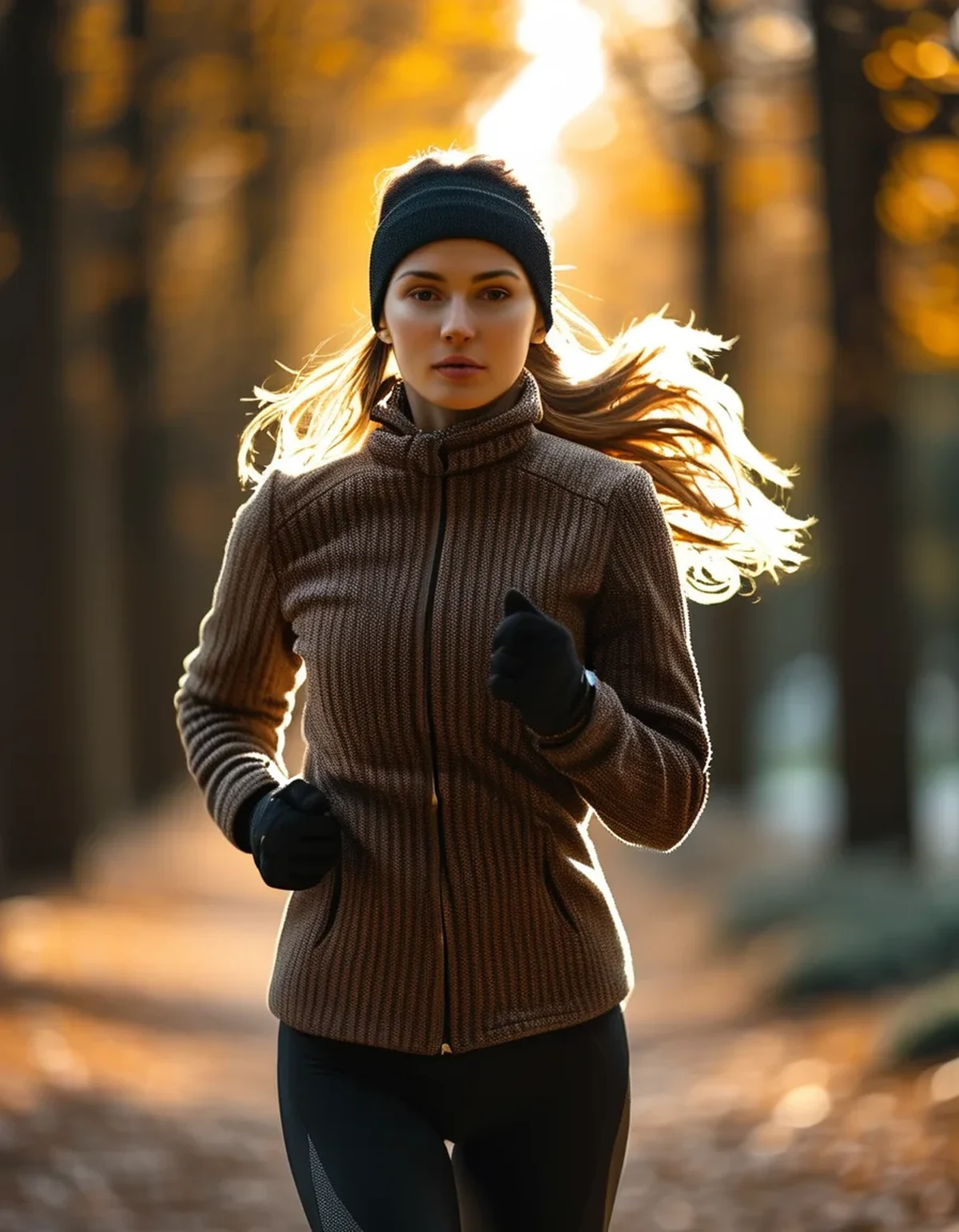
Seen here: Super High Waist Embossed Yoga Leggings with Inner Pocket — shop it on bubblelime.com
Keep Reading
This article is for general informational purposes only and is not medical advice. Always consult a qualified health professional for guidance specific to you.