Should You Repeat a Week of Couch to 5K? The Honest Answer
Quick Answer: Repeat a week when you could not complete the run intervals twice in a row, when form or breathing fell apart rather than just felt hard, or when pain - not discomfort - showed up. Move on when you completed the runs, even if they felt awful. Hard is the program working. And before you repeat anything in August, check the weather: heat inflates effort enough to make a fit person fail a run they would pass in October.
Every Couch to 5K forum has the same two people. One is repeating week 4 for the fifth time, waiting for it to feel easy. The other limped through week 6 on willpower and is now injured. Both misread the same signal - so here is how to read it correctly.

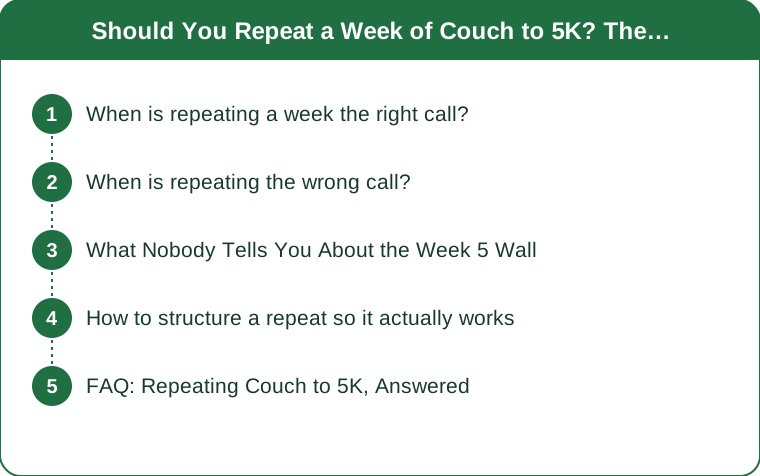
When is repeating a week the right call?
The program is a template, not a contract, and repeating is a designed feature of it - the entire structure assumes some weeks take two attempts. These are the signals that a repeat is genuinely earned:
You could not complete the run intervals on two separate attempts. One failed run is a data point. Two failed runs on different days, with rest between, is a pattern - the jump was too big for where your body is this week, and repeating the previous week rebuilds the base.
You finished, but form collapsed. If the last intervals happened with your shoulders at your ears, your breathing ragged to the point you could not speak a short sentence, and your feet slapping down, you completed the time but not the training. The adaptation you want comes from accumulating relaxed, sustainable minutes.
Pain, as opposed to discomfort. Burning legs and heavy breathing are discomfort - expected and productive. Sharp, localized, or worsening pain in a shin, knee, hip, or foot is different: that is a structure complaining about load it is not ready for. Repeating an easier week - or taking extra rest days - is exactly how you let tendons and bone catch up with your enthusiasm, because they adapt more slowly than your heart and lungs do. If a specific pain persists across two weeks or hurts during daily walking, get it assessed rather than programming around it. This is general information, not medical advice.
Life wrecked the week. Illness, terrible sleep, three missed sessions. Repeating is just honest bookkeeping - you are not repeating, you are actually doing the week for the first time.
When is repeating the wrong call?
More people over-repeat than under-repeat, and the pattern is nearly always the same: they are waiting for a week to feel easy before moving on. It never will, and it is not supposed to.
You completed the runs but they felt very hard. That is the program functioning. Each week is calibrated to sit at the edge of what you can do - if it felt comfortable, the stimulus would be too small to change you. Completion is the bar. Comfort is not.
One bad run scared you. Single bad runs almost always have boring causes: short sleep, a meal too close to the start, a warmer day, a route with a hill you forgot. Look for the cause before you conclude anything about your fitness.
It is August. This one deserves its own line. Heat and humidity raise heart rate and perceived effort dramatically - a run that fails at 85 degrees and humid would often pass easily at 55. If your failed run happened on a hot afternoon, the correct response is usually an earlier start time, a slower pace, and the same week again - not a retreat to an earlier week. Many people repeating weeks in late summer are not under-trained. They are over-heated.
You are three repeats deep and stalled. Repeating the same week more than twice rarely adds anything. At that point the problem is not fitness - it is pace, heat, recovery, or expectations, and one of those needs to change instead.

What Nobody Tells You About the Week 5 Wall
The famous jump is intentional. Week 5 ends with the program’s first long unbroken run, and the leap looks terrifying on paper. It was designed by people who knew exactly what earlier weeks build - the aerobic base to run slowly for that long exists in almost everyone who completed weeks 1 through 4. The barrier is nearly always pace or nerves, not capacity.
Pace is the hidden villain of the entire program. The single most common reason people fail runs is running the intervals too fast - usually because the walking breaks tempt you into restarting at enthusiasm speed. The run portions should feel embarrassingly slow. If you can not speak a sentence out loud mid-run, you are going too fast for the program to work, and slowing down will fix more failed weeks than repeating ever will.
Treadmill and outdoor are different programs. A treadmill holds your pace steady; outdoors you drift faster without noticing. People who fail outdoors after succeeding indoors usually have a pacing problem wearing a fitness costume.
The wall is mostly cognitive. The jump from run-walk to continuous running removes the thing your brain was counting down to. Podcasts, a pre-planned flat route, and covering the app timer all genuinely help, which tells you what the barrier was.
Nobody remembers their repeats. Six months after finishing, no runner can tell you whether they took nine weeks or thirteen. The program has no deadline, and the finish line does not ask.
How to structure a repeat so it actually works
A repeat should change something. Running the identical week in identical conditions and hoping is how people get stuck.
Repeat the run, not necessarily the week. If runs one and two went fine and only the final run failed, redo that run - you do not owe the whole week again. Reserve full-week repeats for weeks that fell apart across the board.
Change one variable. Earlier start before the heat. A flatter route. A deliberately slower pace - slower than feels dignified. Better sleep the two nights before. Pick the one that most plausibly explains the failure and change only that, so you learn something either way.
Add walking, not sitting. On the extra rest days a repeat creates, easy walking keeps the adaptation ticking without adding impact load. Thirty minutes of brisk walking is a legitimate training day at this stage.
Cap it at two, then modify. If a week has beaten you twice, do not run it a third time unchanged. Split the difference instead: extend the walk breaks by thirty seconds, or do the previous week’s final run plus two extra minutes. Building an intermediate rung beats hurling yourself at the same wall.
Protect the streak that matters. The habit of showing up three times a week is worth more than the week number you are on. A repeat that keeps you running beats a progression that ends in three weeks off with a sore shin - and by the time the weather breaks in September, the repeats will have quietly turned into the base that makes autumn running feel like a reward.
FAQ: Repeating Couch to 5K, Answered
Is it OK to repeat a week of Couch to 5K?
Completely. The program is designed with repeats in mind, and finishing in eleven or thirteen weeks instead of nine changes nothing about the result. Repeat when you cannot complete the runs - not when they merely feel hard.
Why can I suddenly not finish runs I could do before?
Check heat first - late summer humidity raises effort enough to fail runs you would pass in cool weather. Then sleep, pacing, and whether you are running your intervals faster than before. Fitness rarely disappears in a week; conditions change constantly.
How slow should Couch to 5K runs be?
Slow enough to speak a short sentence out loud mid-run. For most beginners that is barely faster than a brisk walk, and it is supposed to be. Speed comes later; the program builds duration.
What if I have repeated a week twice and still cannot finish it?
Stop repeating it unchanged. Slow the run pace, lengthen the walk breaks slightly, move sessions to cooler hours, and check recovery basics. Persistent pain during runs or daily walking deserves a professional assessment rather than another attempt.
TL;DR:
- Repeat when you failed the intervals twice, form or breathing collapsed, or pain showed up - not when the runs simply felt hard.
- Completion is the bar for moving on; comfort never arrives and is not the goal.
- In late summer, failed runs are often heat problems - go earlier and slower before you go backward.
- Cap repeats at two, change one variable each time, and keep easy walks on the extra days.
The program does not care what week the app says. It cares that you are still showing up - and on that measure, a smart repeat counts as progress.
Keep Reading
This article is for general informational purposes only and is not medical advice. Always consult a qualified health professional for guidance specific to you.