The Complete Guide to Cadence for New Runners: Why Your Steps Per Minute Matter More Than Your Pace
Quick Answer: Cadence is how many steps you take per minute. Most new runners land somewhere between 150 and 165, and a large body of coaching practice and research suggests that increasing cadence by around 5 to 10% reduces impact loading, shortens overstriding, and lowers stress on the knees and shins. The famous number 180 is a target for experienced runners at speed, not a rule for beginners. Measure your current cadence first, then add 5%, and give it four to six weeks.
The reason cadence deserves this much attention is that it is the one form variable a beginner can measure objectively, change deliberately, and feel the effect of within a single run - which is not true of almost anything else in running form.

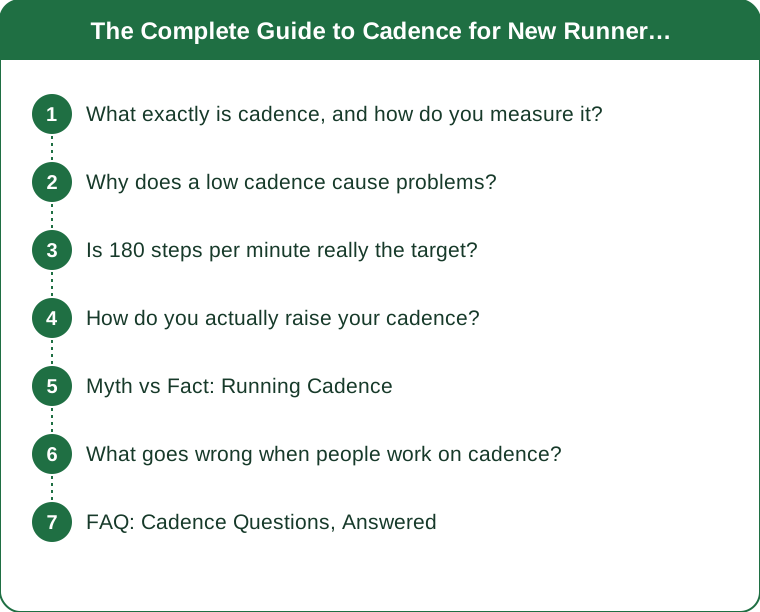
What exactly is cadence, and how do you measure it?
Cadence is your step rate: total footfalls per minute, counting both feet.
The counting confusion. Some sources count steps for one foot only, which halves the number. When you see a figure like 180, it refers to both feet - that is 90 per foot. If you count only your right foot for a minute and get 82, your cadence is 164.
Three ways to measure it, in order of convenience:
1. Count manually. Run at your normal easy effort for at least five minutes so you have settled, then count right-foot strikes for 30 seconds. Multiply by four. Do this three times across a run and take the average - a single count is noisy because you naturally alter your rhythm when you start paying attention.
2. Use a watch or phone app. Almost every running watch and most phone apps report cadence. Wrist-based cadence is generally accurate for running, less so for walking intervals - which matters if you are on a walk-run programme, because the walking portions drag the average down. Look at the cadence of the running intervals specifically, not the session average.
3. Use a foot pod or a treadmill readout. The most accurate, and unnecessary for most people.
What to expect. New runners commonly measure between 150 and 165. Taller runners tend to sit lower, shorter runners higher, and everyone drops when tired. Cadence also varies with speed - it naturally rises as you run faster, which is why comparing your easy-run cadence to somebody else’s race cadence is meaningless.
Do this before changing anything. You need a baseline. Measuring on three separate easy runs, at a similar effort and on similar terrain, gives you a number you can trust.
Why does a low cadence cause problems?
Because a low step rate almost always means a long step, and a long step means landing further in front of your body.
The mechanism, in plain terms. If you take fewer steps to cover the same distance, each step is longer. A longer step usually means the foot lands ahead of your centre of mass with a straighter knee. That position acts like a brake and sends impact force up through the leg with less muscular cushioning available.
What that produces, in the order beginners tend to meet it:
- Shin pain. The classic beginner complaint. Overstriding with a heel-first landing loads the front of the lower leg heavily on each step
- Knee pain, particularly at the front. A straighter knee at contact transfers more load through the joint
- Heavy, loud landings. If you can hear yourself slapping the pavement, you are likely overstriding
- A sense of falling forward and catching yourself rather than flowing
- Hip and lower back tightness from the braking-and-reaccelerating pattern
What the research broadly supports. Studies on cadence manipulation have fairly consistently found that increasing step rate by around 5 to 10% reduces vertical loading rate, reduces braking force, and reduces load at the knee and hip. It is one of the better-supported form interventions available. What it does not do reliably is make you faster - at least not directly, and not immediately.
An important caveat. Cadence is a symptom as much as a cause. Overstriding often comes from weak hips, a poor lean, or simply from copying the long stride people associate with running. Raising cadence forces a shorter step, which addresses the mechanics from the other end - which is why it works even when the underlying cause is something else.
Is 180 steps per minute really the target?
No, not for a beginner, and the origin of that number is worth knowing.
Where 180 came from. A coach counted the step rate of elite distance runners at the 1984 Olympics and observed that essentially all of them were at or above 180. That is an accurate observation about elite runners racing at elite paces. It was never a measurement of what recreational runners should do at a 12-minute mile.
Why it does not transfer directly:
- Cadence scales with speed. Elite runners in that sample were running considerably faster than anyone in a beginner programme
- Cadence scales with height. Taller runners have longer levers and naturally sit at a lower rate
- Cadence varies enormously between individuals at the same speed and height
The better approach is relative, not absolute. Measure your own baseline and target roughly 5% higher. If you run at 158, aim for 166. If you run at 168, aim for 176. A 5% increase captures most of the biomechanical benefit and is achievable without wrecking your running economy. Ten percent is the upper end of what is usually recommended and should be approached in stages.
Why jumping straight to a big increase backfires. A large, sudden cadence change raises your energy cost noticeably - your heart rate goes up at the same pace and running feels harder. That is a normal short-term adaptation cost, and it is proportional to the size of the change. A 5% shift is barely noticeable after two weeks. A 20% shift feels awful for a month and most people abandon it.
A note on where you actually are in a C25K programme. If you are in the early weeks with short running intervals, cadence work is genuinely useful and low risk - the intervals are short enough that fatigue is not yet degrading your form. If you are in the late weeks with 20-plus minute continuous runs, introduce cadence work in the first half of the run only, while you are fresh.

How do you actually raise your cadence?
With an external rhythm, in short doses, over several weeks. The method matters more than the intent.
A metronome is the most effective tool, and it is free. Set a metronome app to your target rate and run to it. Many runners find the beat easier to follow if they set it to half the target - 83 beats for a 166 cadence - and land one foot per beat.
Music at a matched tempo works nearly as well and is more pleasant. Playlists at specific BPM are widely available. The drawback is that you drift when the track changes.
The progression that works:
Weeks 1 and 2: Use the metronome for one to two minutes at a time, three or four times within an easy run. Do not try to hold it for the whole session. The goal is teaching the rhythm, not sustaining it.
Weeks 3 and 4: Extend to three to five minute blocks. Start noticing whether you can hold it without the metronome for a minute afterwards.
Weeks 5 and 6: Use it at the start of a run to set the rhythm, then run without it and check your watch periodically. By this stage the new cadence should feel less deliberate.
Beyond that: Check monthly. Cadence drifts back under fatigue and after a break, which is normal.
Three cues that help when the metronome is off:
- Think quicker, lighter, quieter. Aiming for a quieter landing produces a shorter step almost automatically
- Land under your hip, not out in front. The visual of your foot landing beneath you rather than ahead is the core change
- Lean slightly from the ankles, not the waist. A small whole-body forward lean makes a quicker turnover feel natural rather than forced
What not to do: do not try to raise cadence by pushing off harder or lifting your knees higher. Both increase effort without shortening the step. The change you want is a shorter, quicker step with the same or less effort.
Myth vs Fact: Running Cadence
Myth: Higher cadence makes you faster. Fact: Speed is stride length times cadence. Raising cadence while shortening stride typically leaves pace roughly unchanged in the short term. The benefit is reduced loading and reduced injury risk, which lets you run more consistently - and consistency is what makes you faster.
Myth: Everyone should be at 180. Fact: 180 is an observation about elite runners at race pace. Individual optimal cadence varies with height, speed, leg length, and training history. Your baseline plus 5% is a far more useful target.
Myth: You should change your footstrike, not your cadence. Fact: Deliberately changing footstrike - forcing a forefoot landing, for example - has a mixed evidence base and a real injury risk, particularly to the calf and Achilles. Raising cadence often shifts footstrike naturally as a side effect, which is a gentler route to the same place.
Myth: Cadence should be the same on hills, trails, and flats. Fact: It should not be. Cadence rises going uphill and typically drops going downhill and on uneven terrain. Measuring on a flat, familiar route gives you a comparable number.
Myth: If your cadence is already high, you have nothing to gain. Fact: Correct, and worth stating plainly. If you measure at 175 as a beginner, leave it alone. Raising cadence beyond your natural range costs energy and delivers nothing. The third mistake in the list below catches people here.
Myth: You need a running watch to work on cadence. Fact: A 30-second count and a free metronome app cover everything in this article.
What goes wrong when people work on cadence?
Six predictable failure patterns, most of them recoverable.
1. Changing too much at once. A jump from 155 to 180 is a 16% change. It raises energy cost sharply, makes every run feel harder, and usually ends in abandonment within a fortnight. Five percent, then reassess.
2. Changing cadence and increasing volume in the same week. Both are training stresses. Doing them together is how a manageable adaptation becomes an injury. Hold your weekly distance flat while you change cadence.
3. Fixing something that was not broken. If you are already at 172 to 178 and have no pain, cadence is not your limiting factor. Spend the attention on consistency and strength work instead.
4. Only measuring on the treadmill. Treadmill cadence typically runs slightly higher than outdoor cadence at the same effort, because the belt assists leg turnover. Measure outdoors if you run outdoors.
5. Losing it when tired. Cadence drops as you fatigue - that is universal and not a failure. What matters is your cadence in the first half of a run. If it starts high and collapses in the last five minutes, the issue is endurance, not form, and it resolves as fitness builds.
6. Ignoring what is upstream. If overstriding is coming from weak glutes and hip stabilisers, cadence work is a patch rather than a fix. Two short strength sessions a week - single-leg work, glute bridges, calf raises, step-downs - support the change and are the most reliable injury prevention available to new runners.
Signs it is working, over four to six weeks:
- Landings sound quieter
- Shin discomfort reduces or disappears
- Running feels more like rolling forward and less like a series of catches
- The new rate persists for a few minutes after the metronome stops
Signs to back off: new calf or Achilles soreness, which suggests the change has pushed you onto your forefoot too aggressively; or a significant rise in perceived effort at the same pace that has not settled after three weeks.
This is general information rather than medical advice. Persistent shin, knee, or Achilles pain that does not improve with reduced load is worth having assessed by a physiotherapist or doctor rather than trained through.
FAQ: Cadence Questions, Answered
What is a good cadence for a beginner runner?
Whatever your current cadence is, plus about 5%. Most new runners measure between 150 and 165, which makes a realistic target somewhere in the 160s to low 170s.
How do I count cadence without a watch?
Run at easy effort for five minutes, then count right-foot strikes for 30 seconds and multiply by four. Repeat twice more and average the three.
Will higher cadence fix my shin splints?
It often helps, because overstriding is a common contributor and a shorter step reduces the load. It is not a guaranteed fix - shoes, training volume increases, and running surface all matter too.
Should my cadence be the same for walking intervals?
No. Walking cadence is completely different and will pull your session average down. Look at the cadence of your running intervals only.
How long does the new cadence take to feel normal?
Four to six weeks for a 5% change, using the metronome in short blocks. It feels deliberate for the first two weeks and mostly automatic by week five.
Does cadence matter on a treadmill?
It applies, but treadmill cadence typically reads slightly higher than outdoor cadence at the same effort. Do not compare the two directly.
TL;DR:
- Cadence is steps per minute counting both feet; most new runners sit between 150 and 165
- Low cadence usually means a long step landing ahead of your body, which drives shin and knee load
- 180 is an observation about elite racers, not a beginner target - use your baseline plus 5%
- Raise it with a metronome in one to five minute blocks over four to six weeks, holding your weekly distance flat
- Do not change cadence and increase volume in the same week, and do not fix a cadence that is already fine
Measure yours on three easy runs before changing anything. It is the only form variable you can put a number on, and that alone makes it worth an afternoon.
Keep Reading
This article is for general informational purposes only and is not medical advice. Always consult a qualified health professional for guidance specific to you.