The Complete Guide to Restarting Couch to 5K After You Quit
Quick Answer: Restarting Couch to 5K works best when you do not restart where you stopped. Go back two to three weeks from your quitting point, slow your run pace considerably, and add a rest day if you quit through injury or exhaustion. The program fails most often at weeks 3 to 5 for structural reasons - a jump in continuous running volume that outpaces tissue adaptation - and repeating it identically produces the identical result.
You did four weeks. Then life happened, or your shins happened. The plan is still on your phone, quietly judging you.

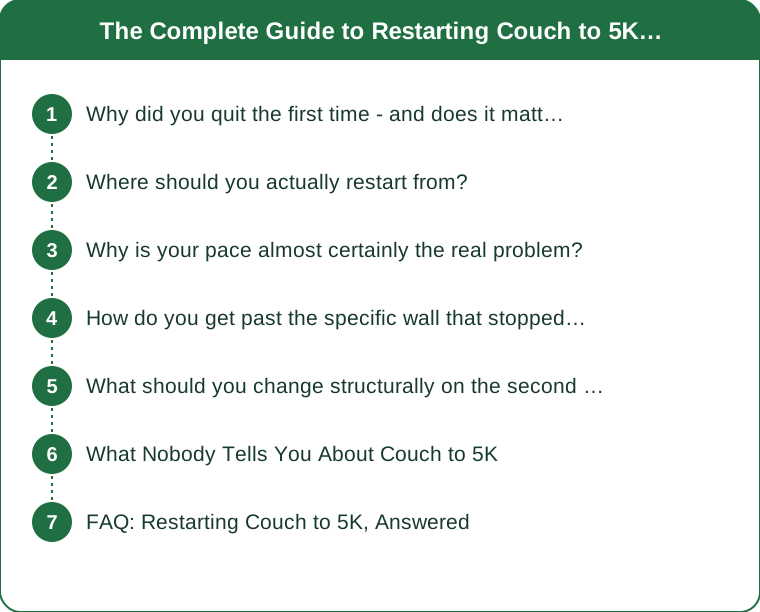
Why did you quit the first time - and does it matter?
It matters enormously, because the correct restart is different for each cause. Nearly every abandonment falls into one of five categories.
1. Injury or persistent pain. Shin pain, knee pain, foot pain, or an ache that stopped being a normal ache. This is the most common physical reason and it typically appears between weeks 3 and 5, when the amount of continuous running increases sharply.
The mechanism is a mismatch in adaptation rates. Cardiovascular fitness improves fast - within two to three weeks you feel meaningfully less breathless. Tendons, bone and connective tissue adapt much more slowly, over months rather than weeks. So the program produces someone whose lungs are ready for more running than their legs are prepared to absorb, and the legs register the complaint.
2. Exhaustion and dread. Not injury - just running that felt uniformly awful and never improved. This is nearly always a pace problem, and it is the single most fixable cause on this list.
3. Schedule collapse. A holiday, a work period, illness, or a change in circumstances broke the rhythm and it never resumed. Fitness loss here is usually smaller than people assume, and the barrier is psychological rather than physical.
4. A specific wall. Week 5 Day 3 - the 20-minute continuous run - accounts for a striking share of abandonments, because it is a large jump in a single session.
5. Boredom or lack of visible progress. Less discussed, but real, particularly for people who are not motivated by the running itself.
Diagnose honestly before you plan. A restart that does not address the cause reproduces the outcome, and the second failure costs more motivation than the first.
Where should you actually restart from?
Not where you stopped. This is the most consequential decision in the entire restart, and almost everyone gets it wrong in the same direction.
The general principle: go back two to three weeks from your quitting point, then progress from there. If you quit in week 5, restart at week 2 or 3.
Why going back is not wasted time:
Detraining is real but uneven. Cardiovascular fitness declines measurably within a couple of weeks of stopping and continues from there, but it also returns faster than it was originally built - the muscle memory effect is genuine at the physiological level. The weeks you repeat will feel easy, and they will pass quickly.
Connective tissue is the actual limiting factor, and it needs the low weeks more than your lungs do. If you quit through injury, those repeated weeks are the treatment, not the tax.
And psychologically, easy weeks rebuild something that failure damaged. Three weeks of sessions you complete comfortably re-establishes the belief that you can complete sessions, which is the resource that ran out last time.
Specific guidance by cause:
- Quit through injury: restart at week 1, add a fourth rest day, and only progress when the previous week was pain-free.
- Quit through exhaustion: restart 2 weeks back and cut your run pace substantially - see the next section.
- Quit through schedule break under 3 weeks: restart 1 week back.
- Quit through schedule break over 6 weeks: restart at week 1 or 2, and accept that it will feel easy for a while.
- Quit at a specific wall: restart 2 weeks back and modify the wall session - covered below.
The one error to avoid: jumping back in at the week you reached because your ego is attached to it. This is the single most reliable way to produce a third attempt.
Why is your pace almost certainly the real problem?
This deserves its own section because it is the most common cause of the exhaustion route out, and the correction is dramatic.
Most beginners run their run intervals far too fast. Not slightly - substantially. The intervals are short, so they feel manageable in the moment, and the natural instinct is to run at what feels like running pace rather than what is sustainable.
The consequence: every session is hard, recovery between sessions is incomplete, the runs never start feeling better, and the whole experience becomes something to dread. The program appears not to be working when in fact it is being run at the wrong intensity.
How slow is correct? The conversational test is the standard and it is reliable: you should be able to speak in full sentences while running. Not gasped words - actual sentences. For most beginners this is a genuinely slow pace, frequently barely faster than a brisk walk, and it feels absurd for the first few sessions.
People resist this for an understandable reason: it feels like it cannot possibly be productive. The physiology says otherwise. Easy aerobic running is what builds the aerobic base, improves capillary density, and develops the tissue tolerance that lets you run longer. Running hard produces fatigue that has to be recovered from rather than adaptation you can build on.
The practical test: if you cannot complete the run intervals while talking, you are running too fast for the program to work as designed.
A useful reframe: the goal of week 3 is not to run fast for 90 seconds. It is to be able to run at all on week 4. Every session should leave you able to do the next one.
And a related point on breathing: breathlessness that forces you to stop is a pace signal, not a fitness verdict. Slowing down fixes it immediately, which is a useful demonstration that the problem was never your capacity.

How do you get past the specific wall that stopped you?
The two most common walls are week 5 day 3 - the 20-minute run - and the general week 3 to 5 volume jump. Both have straightforward fixes.
For the 20-minute continuous run:
Insert a bridge week. Rather than going from 8-minute intervals to 20 continuous minutes, add sessions at 10, 12, and 15 minutes across an extra week. The standard progression is aggressive at this point and there is no rule preventing you from softening it.
Slow down more than you think is necessary. A 20-minute run at a pace you can hold is achievable for most people who have completed week 4; the same 20 minutes at week 4’s interval pace is not. The interval pace was always too fast for continuous running - that is the actual reason this session breaks people.
Break the mental unit. Twenty minutes is intimidating as one block. Four blocks of five minutes, counted separately, is the same run and a considerably easier task.
Change the route. An out-and-back means you have to run home. A loop with no shortcut removes the option of stopping.
For the general week 3-5 volume jump:
Repeat weeks freely. There is nothing sacred about nine weeks - the schedule is a template, not a prescription. Repeating week 4 twice, or three times, is a completely legitimate way to complete the program.
Add a rest day. Three runs a week with a day between is standard; four rest days when you are struggling is sensible rather than weak.
Cross-train on the off days with cycling, swimming or walking. It builds aerobic fitness without loading the same tissues, which is exactly the constraint you are working around.
What should you change structurally on the second attempt?
Five changes that materially raise the odds, beyond pace and starting point.
1. Fix the shoes if you have not. Running in old trainers or in shoes designed for something else is a common contributor to shin and knee complaints. Shoes do not need to be expensive, and they do need to be running shoes with life left in them. A gait assessment at a running shop is free in most places and takes twenty minutes.
2. Add strength work, twice a week, briefly. Calf raises, glute bridges, single-leg balance work, and step-downs. Ten minutes twice a week meaningfully improves tissue tolerance, and calf strength in particular is protective for the shin and foot problems that end most attempts. This is the highest-return addition available and almost nobody does it.
3. Fix the surface if you can. Softer surfaces reduce impact loading. Grass, trail, or a track is easier on legs than pavement - and if pavement is the only option, that is a reason to progress more slowly rather than a reason not to run.
4. Build the schedule around your actual life. The most common schedule failure is planning runs at a time that only works on a good week. Pick the time that works on your worst week, even if that means fewer or shorter sessions.
5. Change how you measure success. Completing three sessions a week is the metric that predicts finishing. Distance, pace, and week number do not - and for a beginner they are actively misleading, because progress in the early weeks is mostly invisible and mostly happening in tissue rather than in times.
And a sixth, which is about the restart specifically: tell someone you have restarted, or run with someone once a week. Social accountability is one of the more reliably effective adherence interventions, and it costs nothing.
What Nobody Tells You About Couch to 5K
Most successful finishers are on their second or third attempt. The narrative of a clean nine-week run to a 5K is not the typical experience. Quitting once is close to the standard path, not a deviation from it, and knowing that changes what a restart means.
The nine-week schedule is a marketing artifact as much as a training design. It is a reasonable template that happens to fit a memorable number. Twelve or fourteen weeks with repeated weeks is a completely normal and arguably better progression for most beginners, and produces the same 5K.
Progress is invisible for the first three weeks and then arrives suddenly. The cardiovascular adaptations are accumulating well before you feel them. A large share of quitting happens in exactly the window before the improvement becomes noticeable, which is a genuinely cruel piece of timing.
Being out of breath is normal; sharp or localised pain is not. Learning that distinction is the most useful skill of the whole program. Muscle soreness one or two days after is expected. Pain during running, pain that worsens through a run, or pain in a specific point is a stop signal. Persistent pain warrants a professional opinion - this is general information, not medical advice.
The walk intervals are not a compromise. They are the mechanism. Walk-run is a legitimate training method used by experienced runners for long distances, not a beginner’s crutch to be escaped as quickly as possible.
Weather matters more than you think in August. Running in heat and humidity is genuinely harder - heart rate runs higher at the same pace, and perceived effort rises substantially. A restart in late summer will feel harder than the same week in October, which is worth knowing so you do not read the weather as a fitness verdict.
And finally: the 5K is not the point, and treating it as the finish line is why so many people stop running the week after they complete it. The habit is the outcome. The 5K is just where the app stops giving instructions.
FAQ: Restarting Couch to 5K, Answered
How much fitness do I lose after stopping for a month?
Measurable, but less than it feels, and it comes back faster than it was built. Most people are surprised how quickly the early weeks feel easy again on a restart.
Should I restart from week 1 even if I got to week 6?
If you stopped through injury, or the break was longer than about six weeks, yes. Otherwise two to three weeks back is usually enough. The cost of going back too far is a few easy weeks; the cost of not going back far enough is a third attempt.
Is it normal to be slower than last time?
Completely, especially in summer heat. Pace in the early weeks is not a useful measure of anything.
Can I do the program four or five times a week to catch up?
No. The rest days are when adaptation happens, and compressing the schedule is the most direct route back to injury. Three runs a week with rest between is the design.
What if I quit again?
Then you restart again, two to three weeks back, with one more thing changed. The people who finish are not the ones who never quit - they are the ones who restarted after they did.
TL;DR:
- Restart two to three weeks before where you quit - repeated easy weeks are the treatment, not lost time
- Almost everyone runs too fast; you should be able to talk in full sentences throughout
- Weeks 3 to 5 break people because tissue adapts slower than lungs do - repeat weeks freely
- Add ten minutes of calf and glute work twice a week; it is the highest-return change available
- Measure success by sessions completed per week, not pace, distance, or week number
Most finishers are on their second attempt. That is the normal path, not a failure.
Keep Reading
This article is for general informational purposes only and is not medical advice. Always consult a qualified health professional for guidance specific to you.