The Complete Guide to Your First 5K Race After Finishing Couch to 5K
Quick Answer: The three things that go wrong at a first 5K are starting too fast, eating something unfamiliar, and standing too far forward at the start. Pick a race four to six weeks after finishing the program, keep training as you have been with one race-pace session a week, eat only what you have eaten before training runs, line up in the back third, and run the first kilometre deliberately slower than feels right. Almost everyone who has a bad first 5K went out too fast in the first 90 seconds, and it is entirely preventable.
Finishing the program is the hard part and you have done it. What follows is a different set of skills, and none of them are fitness.

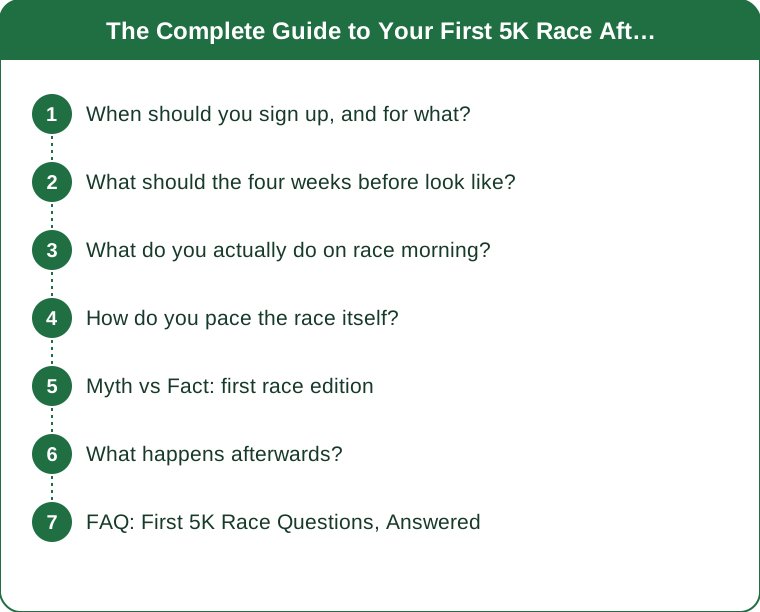
When should you sign up, and for what?
Timing: four to six weeks after your final program run is the sweet spot. Long enough to add a couple of race-pace sessions and a little confidence, short enough that fitness has not drifted.
Choosing the race matters more than people expect.
Look for:
- A flat course. Elevation on a first race turns a manageable effort into a demoralising one. Check the course map - most events publish one.
- A field of a few hundred to a couple of thousand. Very small races can leave you running alone; very large ones have congested starts.
- A local, familiar route if possible. Knowing where the turns are removes a surprising amount of mental load.
- A morning start. Fewer hours of anticipation, and usually cooler.
A free weekly timed 5K is the ideal first one. No entry cost, no pressure, a friendly field, and you can do it again the following week if it goes badly. Many people do one or two of these before an official race, and it removes essentially all the unknowns.
What to avoid for a first race: trail races with technical footing, anything described as undulating or scenic (both usually mean hills), themed obstacle events, and races on a date you cannot move if you get ill.
Setting a goal that will not spoil it
Have three goals. A: finish running the whole thing. B: finish feeling like you could have gone faster at the end. C: a time, if you want one. Lead with A. First-race times are heavily influenced by course, weather, and congestion, and a time goal set from treadmill runs frequently produces disappointment about something that was never a fitness issue.
What should the four weeks before look like?
Do not overhaul anything. The most common mistake between finishing the program and racing is a sudden increase in training, which produces fatigue or a niggle right when you want neither.
Weeks 1 to 3 - three runs a week:
- Run 1: easy. 25 to 30 minutes at conversational pace. If you cannot speak in full sentences, slow down.
- Run 2: race pace practice. Warm up 10 minutes easy, then 10 to 15 minutes at the pace you intend to race, then 5 minutes easy. This teaches your body what that effort feels like, which is the entire point.
- Run 3: slightly longer easy run. 30 to 35 minutes. Builds confidence that 5K is comfortably within range.
Week 4 - taper week:
- Cut the volume by roughly a third
- Keep one short race-pace session early in the week, around 8 minutes at pace
- Last run: two or three days before, 20 minutes easy with four 30-second pickups
- Nothing new, no long walks the day before, no first-time yoga class
Strength work: keep whatever you were doing, and stop heavy lower-body work about five days out. Delayed soreness has a 24 to 72 hour peak and can arrive precisely on race morning.
Practising the race conditions: do at least one run at the same time of day as the race, in the exact clothes and shoes you plan to wear, having eaten what you plan to eat. This single rehearsal prevents most race-day surprises.
What do you actually do on race morning?
Two to three hours before: eat something familiar, moderate in carbohydrate, low in fibre and fat. Toast with jam and a banana is the classic for a reason. Nothing you have not eaten before a run. This is the rule people break and regret.
Fluids: 400 to 500 ml of water in the two hours before, then sips. A 5K does not require carrying water, and over-drinking beforehand creates its own problem.
Arrive 45 to 60 minutes early. Collect your number, find the toilets, and expect a queue - budget 20 minutes for it. Being unhurried is worth more than any warm-up.
Pin your number to the front of your shirt, four corners, before you leave the house if you already have it.
Warm up, 15 minutes before:
- 5 minutes very easy jogging
- Leg swings, walking lunges, ankle circles
- Three or four 20-second pickups at roughly race pace, with full recovery
That last part matters. Starting a race completely cold means the first kilometre feels far worse than it should, which is exactly when you are making pacing decisions.
Line up in the back third. This is the most important logistical decision of the day. Standing forward puts you among people who will start fast, and the pull of a fast-moving field is almost impossible to resist. From the back you will spend the whole race passing people, which feels considerably better than the reverse.
Clothing: dress for about 10 degrees warmer than the actual temperature, because you will warm up quickly. Wear an old layer at the start you do not mind removing.

How do you pace the race itself?
The whole race is decided in the first 90 seconds.
Adrenaline, a crowd, and a downhill start combine to produce a first kilometre far faster than anything you have run in training. It feels effortless because of the adrenaline. The bill arrives at 2 km and it is expensive - and once you have gone anaerobic that early, there is no recovering within a 5K.
The pacing plan:
Kilometre 1 - deliberately slower than feels right. Aim for slightly slower than your target pace. You should feel slightly frustrated and restrained. Let people pass you. This is the single highest-return decision in your first race.
Kilometre 2 - settle in. Find your rhythm, check your breathing. This is usually the mentally hardest kilometre - the adrenaline is gone and the finish is not close. Expect it, and it stops being alarming.
Kilometre 3 - hold. Steady effort. Pick a runner ahead and stay with them. Focus on cadence and relaxed shoulders.
Kilometre 4 - this is the race. If you paced correctly, you can now begin passing people. If you went out too fast, this is where it shows. Either way, work here.
Final 800 m - empty the tank. Increase gradually rather than sprinting from the sign. Most people can lift substantially over the last 400 m and finish strong.
During the race:
- Breathe rhythmically. Something like three steps in, two out, keeps it regular.
- Relax your hands and shoulders. Check every few minutes - tension costs energy.
- Do not chase anyone in the first half. Their race is not your race.
- Water stations at a 5K are optional. In cool weather you do not need them, and grabbing a cup mid-effort is more disruptive than helpful.
Myth vs Fact: first race edition
Myth: You should try to negative split your first race.
Fact: Running the second half faster is an excellent goal and an advanced skill. For a first race, aim simply for not slowing down. Even pacing is the achievement, and it will feel like a negative split at the end because everyone around you is fading.
Myth: You need new shoes for your first race.
Fact: New shoes on race day is one of the most reliable ways to produce blisters. Race in the shoes you trained in, with the socks you trained in. Nothing new is a rule and it applies to everything touching your body.
Myth: Carb loading matters for a 5K.
Fact: Carb loading is for events over roughly 90 minutes. Your normal glycogen stores easily cover a 5K. Eat normally the day before and skip the large pasta dinner - a heavy meal the night before more often causes problems than solves them.
Myth: If you have to walk, you have failed.
Fact: Walking for 20 seconds and finishing strong is a better race than grinding out a miserable final kilometre. It is also a completely normal part of a first race. The goal is to finish and want to do another one.
Myth: Your first race time is a measure of your fitness.
Fact: It is a measure of your fitness, the course, the weather, the congestion, how you slept, and your pacing judgment on the day. Treat it as a baseline, not an assessment.
What happens afterwards?
Immediately after: keep walking for 5 to 10 minutes. Stopping dead after a hard effort makes people feel light-headed and stiff. Walk, then drink, then eat something within the hour.
The emotional part nobody warns you about: a lot of people feel slightly flat in the days after a first race. It is a real phenomenon - the goal that has been organising your weeks is suddenly gone. Knowing it is coming makes it much easier.
The next week:
- Two or three easy days - walking, or very easy jogging
- Return to normal running within three to five days
- Book the next one within a week. This is the single best thing you can do for continuing. Having a date on the calendar is what carries people through the flat patch.
Where to go next, in rough order of sensibility:
- Another 5K. Race the same distance again with better pacing knowledge. Most people improve substantially on their second attempt without any fitness change.
- Consolidate. Spend two or three months just running consistently three times a week. This is unglamorous and it is what builds a runner.
- Then, if you want distance, a 10K plan. Do not jump straight there - the injury risk in the months right after starting running is real, and it correlates with rapid increases in volume.
One thing to keep from the program: the structure. The reason it worked was that it told you exactly what to do on which day. Whatever you do next, having a plan on paper beats deciding each morning.
FAQ: First 5K Race Questions, Answered
What if I get to the start line and panic?
Extremely common and it passes within the first kilometre. Slow your breathing deliberately - long exhales - move to the back, and give yourself explicit permission to walk if you need to. Nearly everyone reports the nerves disappearing once they are moving.
Should I run with music?
If you trained with it, yes, and check the race permits it. Many do not allow headphones on open roads for safety reasons, so confirm in advance rather than discovering it at the start - and if you might have to race without, do a couple of training runs without.
How do I know what pace to target?
Your recent training runs tell you. Take your comfortable steady pace from a 30-minute run and target roughly 10 to 20 seconds per kilometre faster. If you have no idea, run the first race entirely by feel - moderate effort you could hold, lifting in the last kilometre - and use it as your baseline.
What if it rains, or it is very cold?
Races run in almost anything. Dress for the temperature minus a layer, use an old bin bag or throwaway top at the start, and accept that wet feet are survivable over 5K. Cold, dry conditions are actually good racing weather.
Is it normal to feel awful at 2 km?
Completely. It is the point where adrenaline has faded and the finish is still distant, and it is where the doubt arrives for almost everyone. It reliably improves by 3 km. Knowing that in advance is most of the fix.
TL;DR:
- Race four to six weeks after finishing the program, on a flat course with a morning start. A free weekly timed 5K is the ideal first.
- Training stays the same: one easy, one race-pace, one slightly longer run per week, then taper the final week.
- Nothing new on race day - not shoes, not socks, not breakfast.
- Line up in the back third and run the first kilometre deliberately slow. Nearly every bad first race starts in the first 90 seconds.
- Have three goals: finish running, finish strong, and a time only if you want one.
- Book the next race within a week - the flat feeling afterwards is real and a date on the calendar fixes it.
You already built the fitness. Race day is a logistics and patience exercise, and both of those are entirely learnable in four weeks.
Keep Reading
This article is for general informational purposes only and is not medical advice. Always consult a qualified health professional for guidance specific to you.